
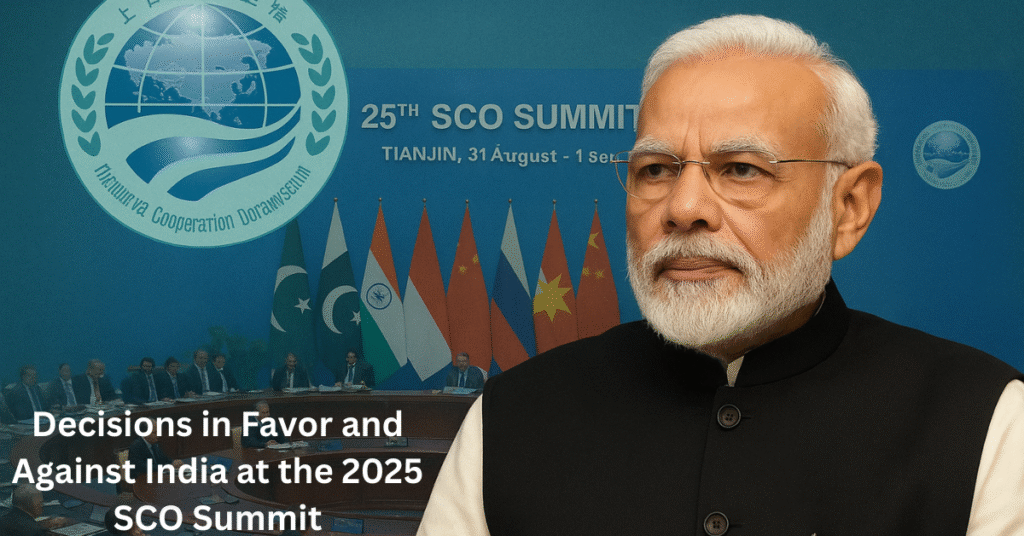
The 25th Shanghai Cooperation Organisation (SCO) Summit, held in Tianjin, China, from August 31 to September 1, 2025, was a significant diplomatic event marked by critical decisions that affected all member states, especially India. India is growing fast and is an important power in the region. When India joined the SCO Summit, it had three main goals: to improve security, build better connections with neighbors, and boost economic cooperation. The summit brought both good results and some challenges for India, showing how complex the relationships and politics are within the SCO group.
Decisions in Favor of India
Strong Stand Against Terrorism with Recognition of Pahalgam Attack
One of the biggest achievements for India at the SCO Summit was getting a clear and strong statement against terrorism. The summit specifically mentioned the tragic terror attack in Pahalgam in April 2025, where 26 people lost their lives. Leaders at the summit agreed on a zero-tolerance policy for terrorism, extremism, and separatism. They highlighted how important it is for countries to work together to stop the funding of terrorists and to prevent the spread of extreme ideas that can lead to violence. This was a major diplomatic win for India, which has long asked the SCO to recognize and act against terror activities affecting the country.
This clear mention of the Pahalgam attack was important because earlier, at the Defense Ministers’ meetings within SCO, some countries, especially Pakistan tried to weaken the language condemning terrorism. But India was firm, and at the leaders’ summit, the attack was explicitly named, showing India’s success in pushing for accountability and stronger security cooperation.
Emphasis on Connectivity and Economic Integration
India’s vision of connectivity projects received strong endorsement at the summit. Prime Minister Narendra Modi highlighted India’s support for significant regional initiatives like the operationalization of the Chabahar Port and the International North-South Transport Corridor (INSTC). These projects are crucial for enhancing India’s trade links with Central Asia, the Middle East, and beyond, thereby bypassing geopolitical hurdles, including Pakistan-centric routes.
The SCO Summit agreed on a plan called the SCO Development Strategy that will guide efforts until 2035. Along with this, they also plan to set up a new SCO Development Bank. This gives India a chance to get funding for big infrastructure projects and to grow economic ties with other member countries. This fits well with India’s goal to increase trade and investment in the region while keeping its own independence in decision-making.
Reformist Agenda and Multilateralism
India’s call for reforming international institutions, including the United Nations Security Council, to better represent the Global South received widespread support. The Tianjin Declaration and the summit discussions emphasized a just, multipolar international order that reflects the aspirations of developing nations, an agenda strongly championed by India.
Prime Minister Modi’s proposal for a Civilizational Dialogue Forum within the SCO to foster people-to-people ties was well-received, showcasing India’s soft power and cultural diplomacy. Additionally, the focus on innovation, startups, youth empowerment, and sustainable development aligns with India’s developmental priorities, creating an opportunity for India to leverage the SCO’s platform to achieve its domestic and international policy objectives.
Decisions Not Fully in Favor of India
Limited Direct Reference to Pakistan in the Terrorism Context
Although the summit condemned terrorism and mentioned attacks like the one in Pahalgam, it did not directly name Pakistan in the official statements. Pakistan has always opposed being linked to terrorist groups in the SCO meetings, and this caused some disagreements.
India tried to diplomatically isolate Pakistan within the SCO, but faced pushback from other members. This shows how the SCO works by consensus, which means it avoids strong statements targeting specific countries. While this approach keeps the group together, it was frustrating for India because it made it harder to take a united stand against terrorism.
China’s Dominant Influence and Belt and Road Initiative (BRI)
China’s continuing dominance within the SCO and its strong advocacy for the Belt and Road Initiative remain sensitive issues for India. The BRI includes projects in Pakistan-occupied Kashmir (PoK), which India objects to on sovereignty grounds. Despite India’s objections, the SCO summit did not seriously challenge China’s BRI agenda, signaling the limits of India’s influence on certain economic and geopolitical matters within the forum.
Furthermore, India has had to balance its growing engagement with the SCO alongside its strategic recalibration with the United States and its partners, especially within the Quad framework. This multi-alignment complicates India’s ability to fully leverage the SCO for geopolitical gains without antagonizing China or Russia, both pivotal players in the SCO.
Border Disputes and Security Challenges
The summit helped improve India-China relations a bit, with Prime Minister Modi meeting President Xi Jinping in China for the first time in seven years. But the border issues However, the border problems between India and China are still not resolved. The SCO provides a place for talks, but it hasn’t been able to fix these long-standing issues. India stays cautious by keeping its troops ready along the Line of Actual Control (LAC), while also trying to reach agreements to reduce troop presence in certain places.
The SCO’s focus on working together for security is important. But India still sees some members, especially Pakistan, as causing trouble. So, security cooperation in the SCO is still a challenge for India.
India’s Balanced Approach at the SCO Summit
India’s involvement in the SCO shows a careful and balanced approach. It takes part actively but also protects its own national interests. Aligning with SCO’s reformist and multipolar vision, India advocates firm counter-terrorism measures and regional connectivity. Still, it is cautious about economic dominance that undermines its policy autonomy.
The strategic use of multiple platforms, such as BRICS, SCO, Quad, and G20, enables India to navigate diplomatically amid complex regional rivalries. India’s success at the 2025 SCO Summit underscores its growing diplomatic maturity, as it asserts its voice while delicately managing contentious issues.
Conclusion
The 2025 SCO Summit was very important for India. It helped India make strong progress, especially in fighting terrorism and improving connections with neighbors. But some problems still remain, like Pakistan avoiding criticism, China’s strong influence in the economy, and border disputes that are still not solved.
India’s role in the SCO is a careful balancing act. It wants to make the most of the benefits while dealing with the challenges. The summit showed that India is a responsible country, committed to peace, growth, and working together with others as the world changes.






2 thoughts on “SCO Summit 2025: What Went in India’s Favor and What Didn’t”