Introduction
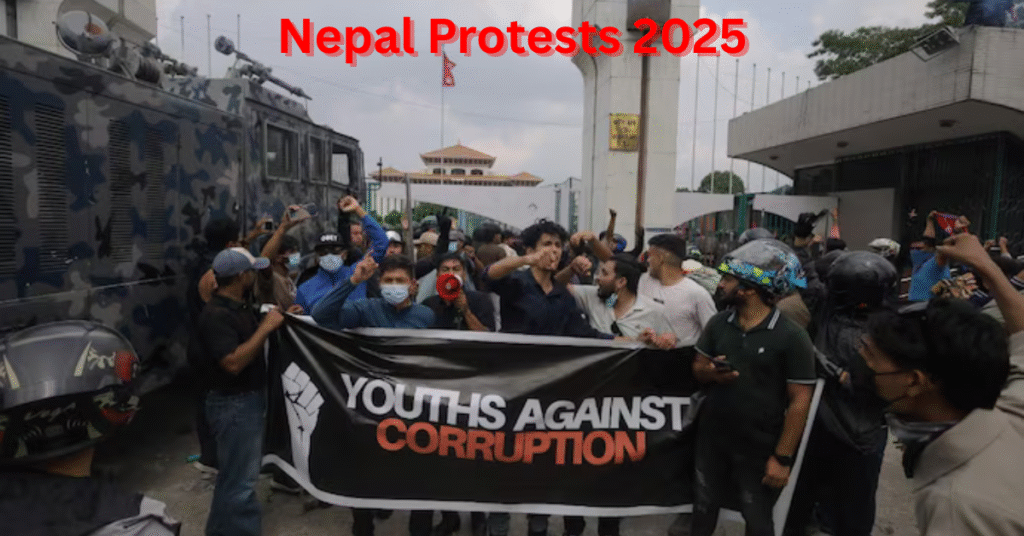
Nepal’s Gen Z-led protest and reshaped the country’s political landscape in days. What started as anger over a sweeping social media ban and years of corruption and favoritism exploded into arson, assaults, and resignations at the highest level. Prime Minister K.P. Sharma Oli stepped down as parliament burned, ministers fled under curfew, and protesters targeted homes and offices linked to political elites — a rare, raw reckoning with power in Kathmandu and beyond.
K.P. Sharma Oli — resignation under fire
K.P. Sharma Oli quit after two days of deadly clashes. Protesters set fire to parliament and other government buildings, and even reached homes of politicians. Reports said his house in Balkot was also attacked. The army then took control of the streets, and curfews spread across the valley. His resignation showed how badly authority had broken down and kicked off talks for an interim government.
Sher Bahadur Deuba and Arzu Rana Deuba — assaulted amid chaos.

Former prime minister Sher Bahadur Deuba, head of the Nepali Congress, and his wife, Foreign Minister Arzu Rana Deuba, were assaulted during the peak unrest, with footage and wire accounts showing both injured and escorted to safety. Their residence came under attack as crowds vented fury at senior figures across parties. The incident underscored how fast the protests turned from slogans to street violence.
Also Read: Nepal Protests 2025: Why Gen Z Took to the Streets Against Corruption and Censorship – lostnews
Pushpa Kamal Dahal “Prachanda” — homes targeted
The residence of former PM Pushpa Kamal Dahal, also known as Prachanda, was set on fire, with additional damage reported at properties linked to his family, including his daughter Ganga Dahal’s home in Lalitpur. The symbolism was stark: protesters striking at leaders of different ideological camps, united mainly by their status in the political elite.
Bishnu Prasad Paudel — chased and beaten.
Deputy Prime Minister and Finance Minister Bishnu Prasad Paudel was chased, stripped, and beaten by mobs in a widely circulated episode that captured the raw anger on the streets. The attack happened as ministers and lawmakers tried to move under curfew, with some evacuated by helicopter from Lalitpur’s Bhaisepati area, according to broadcast reports.
Prakash Man Singh — residence torched
Deputy Prime Minister Prakash Man Singh’s house and vehicle were set on fire, part of a cascade of attacks on top officials’ properties across Kathmandu. The targeting of Singh, a senior Nepali Congress leader, again showed that anger crossed party lines — a backlash against a whole political class rather than one bloc.
Ramesh Lekhak’s former home minister’s house was set on fire.
Former home minister Ramesh Lekhak’s residence in Naikap, Kathmandu, was torched, one of several arson attacks against leaders’ homes as protests escalated. The assault followed his resignation, and it became one of the night’s most cited examples of the unrest spinning into personal violence.
Bidya Devi Bhandari — former president’s residence attacked
The residence of former president Bidya Devi Bhandari in Bhangal, Kathmandu, was attacked and set ablaze during the melee, according to compilations of incidents from the protests. It highlighted how even retired or former office-holders were pulled into the storm once the crowd’s focus shifted to symbols of power and privilege.
Other national and provincial leaders — a widening map of targets
Attacks and vandalism spread far beyond the capital. In Rupandehi, homes linked to leaders such as Bal Krishna Khand and Bhoj Prasad Shrestha, as well as several mayors, were burned, while in Karnali Province, the provincial parliament building and the residence of Chief Minister Yam Lal Kandel were set on fire. In Koshi Province’s Biratnagar, the district office, district court, and the chief minister’s residence were attacked, showing how the protests morphed into a nationwide challenge to officialdom.
Names connected to ministries — more hits as state power faltered
The house of Prithvi Subba Gurung, the communications and IT minister, was set ablaze in Lalitpur. At the same time, stones were thrown at Deuba’s Budhanilkantha home and at properties tied to multiple cabinet members. With the army patrolling and curfews in force, some ministers were reportedly airlifted to safety as mobs overran neighborhoods where leaders traditionally lived.
A tragic focal point: the former PM’s wife
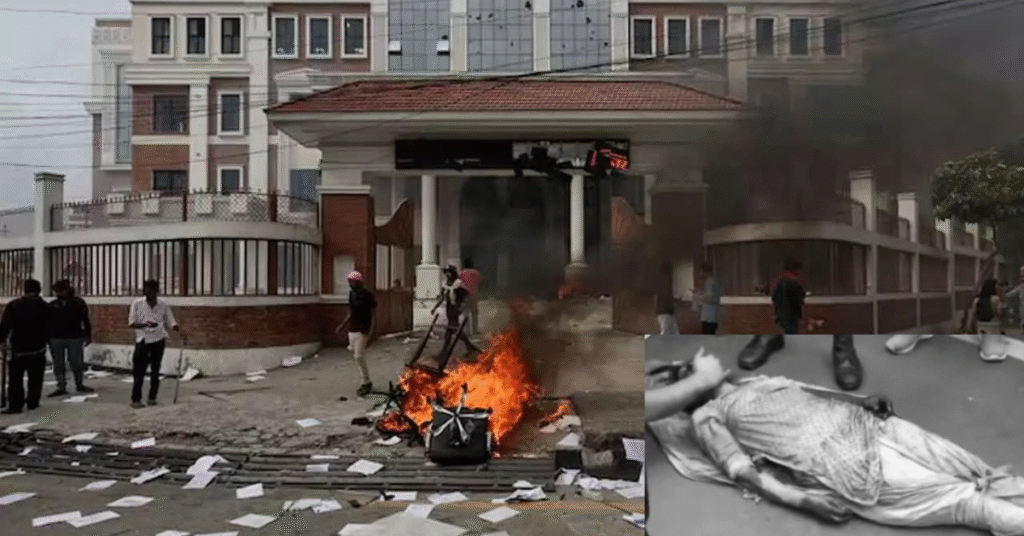
The saddest moment of the unrest was the death of Rajyalaxmi (Rabi Laxmi) Chitrakar, the wife of former Prime Minister Jhala Nath Khanal. Protesters allegedly set the Khanal family home on fire, and she suffered severe burns; she was taken to the hospital but did not survive, according to family sources and multiple news reports. While some outlets initially noted a lack of official confirmation, subsequent reporting widely treated her death as a grim fact of the violence. The case became a flashpoint in the national conversation — proof for many that rage had crossed a line and that families were paying an unbearable price.
How parliament and courts became flashpoints
Protesters set the Parliament structure and the Supreme Court on fire — unprecedented scenes that reverberated across the world’s newswires. The New York Times noted that two cabinet members resigned amid the chaos. At the same time, live pages and international analyses described a capital under military curfew and an elite in retreat. The targeting of “temples of the state” alongside private homes signaled a movement that saw little daylight between institutions and the people who occupied them.
Also Read: SCO Summit 2025: What Went in India’s Favor and What Didn’t – lostnews
Why were these politicians in the crosshairs?
International reporting highlighted a common thread: anger at corruption, the “Nepo Kids,” lavish lifestyles, and a sweeping social media ban that many perceived as censorship. Reuters framed the attacks on luxury hotels and leaders’ residences as backlash against a gilded elite in one of the world’s poorer countries. At the same time, broadcast clips showed ministers running for safety. Regardless of party, high-profile names carried the weight of public frustration built over the years.
Where things stand for the political class now
With Oli gone, attention turned to an interim solution — and repeatedly to the name of former Chief Justice Sushila Karki as a potentially acceptable, technocratic leader. Negotiations have featured the army and the presidency as central actors. At the same time, rights groups and media called for transparent investigations into deaths, arson, and alleged abuses. For many politicians, the near-term reality is security details, damaged homes, and a harder public line on accountability.
Key names and reported fates at a glance
- K.P. Sharma Oli — resigned as prime minister; residence attacked.
- Sher Bahadur Deuba — assaulted; home targeted; rescued under protection.
- Arzu Rana Deuba — foreign minister; assaulted alongside Deuba.
- Pushpa Kamal Dahal “Prachanda” — residence set on fire; family properties attacked.
- Bishnu Prasad Paudel — chased and beaten by mobs.
- Prakash Man Singh — house and vehicle torched.
- Ramesh Lekhak — former home minister; house set on fire.
- Bidya Devi Bhandari — former president; residence attacked.
- Rajyalaxmi Chitrakar — wife of former PM Jhala Nath Khanal; died of burn injuries after an arson attack on her home.
The bottom line
The 2025 protests didn’t just topple a government; they shattered the sense of untouchability around Nepal’s political class. As homes burned and leaders scattered, the message was unmistakable: legitimacy must be earned with transparency and service, not titles. The death of a former PM’s wife brought the human cost into painful focus, and it’s likely to drive both demands for justice and a sober reassessment inside Nepal’s parties. Whether a credible interim leadership can channel this moment into lasting reform is the question that will define the next chapter.