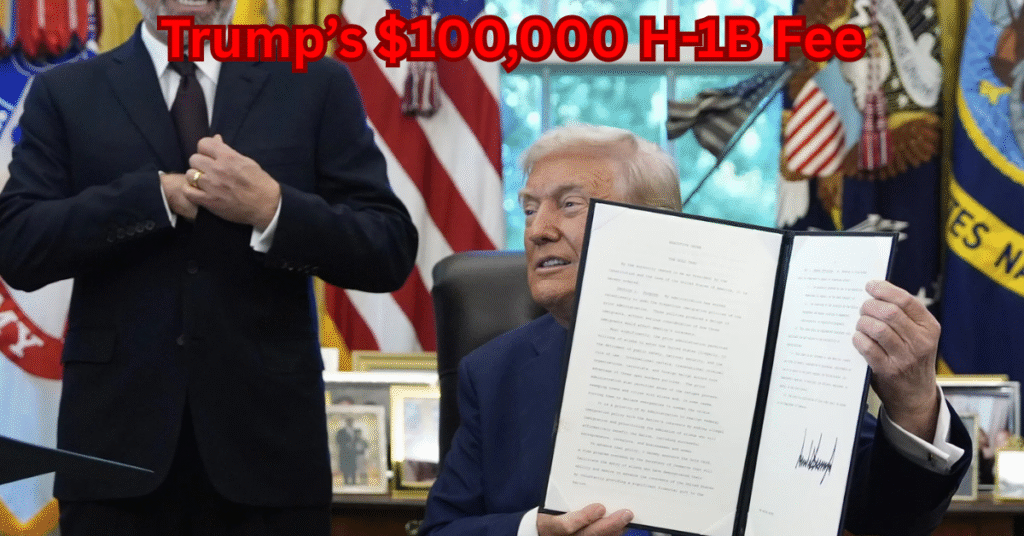
Trump’s new H‑1B fee: What changed and what it means
President Donald Trump signed a proclamation imposing a new $100,000 annual fee on most new H‑1B visa petitions, significantly altering the economics of hiring high‑skilled foreign workers and creating immediate travel and compliance concerns for employers and professionals, especially those from India. The measure takes effect quickly and conditions entry and approvals on payment, with limited national‑interest exceptions.
What was signed
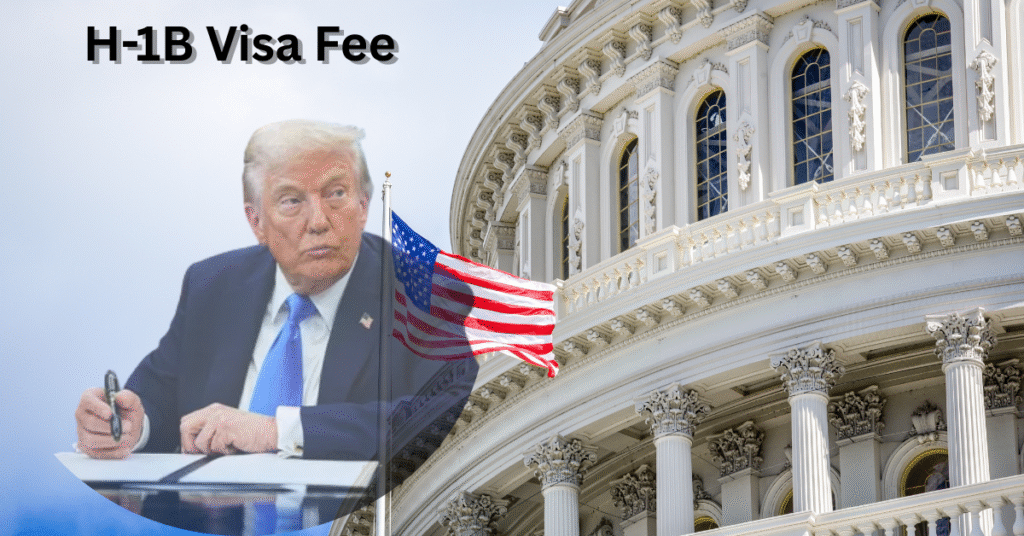
- A presidential proclamation restricts the entry of H‑1B specialty‑occupation workers unless the sponsoring employer pays a $100,000 fee per petition, layering this cost on top of existing filing and anti‑fraud charges for a defined period stated in the order.
- The White House outlined enforcement directions to the Departments of Homeland Security, State, and Labor to tighten verification, focus on higher wages, and pursue related rulemaking that prioritizes higher‑paid roles in selection and adjudication.
Also Read: Explained: U.S. 50% Tariffs on Indian Exports and What It Means for You – lostnews
Who Will Be Most Affected by the $100,000 Fee
- H‑1B beneficiaries outside the United States and new cases are most directly impacted because entry and approvals can be withheld if the fee is not paid, subject to narrow national‑interest exemptions.
- Employers with H‑1B staff currently abroad face immediate travel risk management, as workers attempting to enter without the new payment could be delayed or refused.
Why did the administration do it?
- The stated rationale is to deter the displacement of U.S. workers and ensure sponsorship only where a role is sufficiently high‑value to justify the new cost, reinforcing a preference for training or hiring domestically where feasible.
- Officials also frame the fee as a filter that targets alleged program misuse while reserving relief valves for critical skills and public interest scenarios.
Industry reaction and near‑term impacts
- Tech, consulting, and healthcare employers forecast hiring pauses, travel freezes, and case triage while they re‑model budgets and staffing plans around a six‑figure per‑worker levy.
- Larger firms with deep pockets may absorb the costs associated with priority roles. Still, startups, mid‑size companies, and academic or nonprofit employers could struggle to justify sponsorship at the new price point.
Exemptions and discretion
- Agencies retain authority to grant national‑interest exceptions for specific people, employers, or sectors, but those are expected to be narrow and require robust justification.
- Guidance is also expected to discourage misuse of visitor categories as workarounds, tightening alternative pathways.
Immediate steps for employers
- Inventory pending and active H‑1B cases, flag beneficiaries who are abroad or have near‑term travel, and decide which roles warrant the $100,000 payment or an exemption request.
- Implement temporary travel holds for H‑1B staff, coordinate closely with immigration counsel, and prepare documentation proving payment or exception eligibility before consular or port‑of‑entry processing.
Implications for Indian professionals

- Given that Indians make up the majority of H-1 B recipients, the policy disproportionately affects Indian tech talent and Indian IT services firms, with likely shifts toward O-1, L-1 intra-company transfers, or offshore delivery models.
- Individuals outside the U.S. face the greatest immediate risk; those inside may still see tighter scrutiny on extensions, amendments, and portability decisions as employers reassess costs.
What is the H‑1B visa?
- The H‑1B is a non-immigrant visa classification that lets U.S. employers temporarily hire foreign workers in “specialty occupations,” typically roles requiring the theoretical and practical application of highly specialized knowledge and at least a bachelor’s degree in a directly related field.
- Core features include employer sponsorship, compliance with a Department of Labor Labor Condition Application (prevailing wage and working‑conditions attestations), and a congressionally set annual cap of 85,000 new visas (65,000 regular cap plus 20,000 for U.S. advanced‑degree holders), selected by lottery when registrations exceed supply.
- Status is usually granted for up to three years, extendable to six, with possible extensions beyond six years tied to progress in the employment‑based green card process; the category permits “dual intent,” meaning an H‑1B worker can pursue permanent residency while in temporary status.
- Typical qualifying fields include engineering, computer science, mathematics, finance, healthcare, and other professions where the job requires a specific degree and specialized expertise; employers must maintain a bona fide employer‑employee relationship and pay at least the higher of prevailing or actual wages.
Also Read: Understanding the Impact of Tariffs and 401(k) Updates on Your Finances – lostnews
What to watch next
- Legal challenges will likely test presidential authority to condition entry on a payment and scrutinize how agencies implement and adjudicate exemptions.
- Forthcoming DHS and Labor rulemakings on wage prioritization and selection criteria will determine how much the new framework reallocates demand toward the highest-paid, highest-skilled roles.