

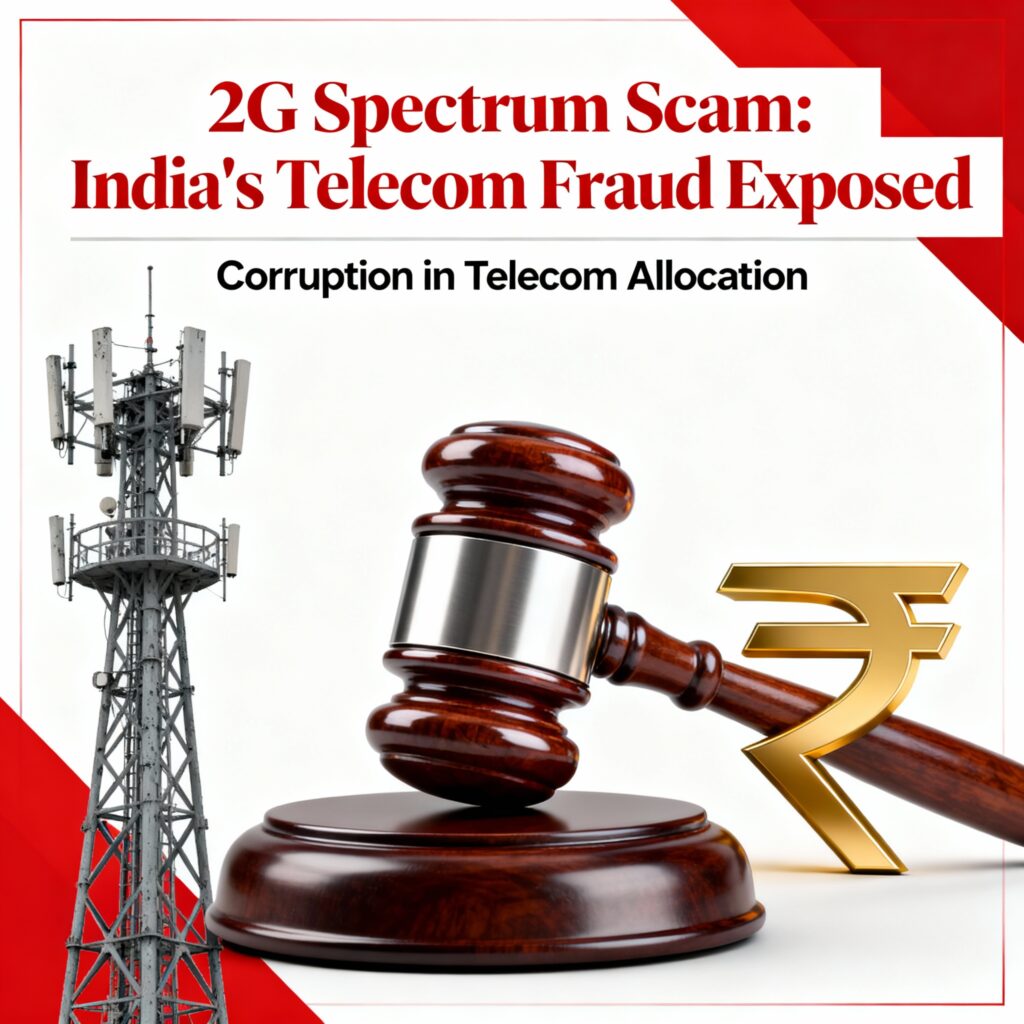
The 2G Spectrum Scam is widely regarded as one of the biggest financial scandals in India’s history. It exposed deep-rooted corruption in the telecom sector and shook public trust in the government during the late 2000s. The scam revolved around the allocation of 2G spectrum licenses — the radio frequencies used by mobile networks — at prices well below their market value. What should have been a transparent, competitive bidding process turned into a massive financial loss for the country.
What Is 2G Spectrum and Why Does It Matter?
To understand the scam, it’s important to know what 2G spectrum means.
“2G” stands for second-generation mobile communication technology, which allowed people to make calls, send SMS, and use limited internet services on their phones. Telecom companies need spectrum — a limited and valuable natural resource — to operate their mobile networks.
The government owns this spectrum and allocates it to private companies through auctions or fixed licenses. Ideally, this process should be fair and open so that the public gets the best return for a national resource. But in 2008, things went very differently.
How the 2G Spectrum Scam Happened
In 2008, the Department of Telecommunications (DoT), under the Ministry of Communications and Information Technology, was headed by A. Raja, a member of the Dravida Munnetra Kazhagam (DMK) party.
Instead of conducting an open auction for spectrum licenses — which would have allowed companies to bid competitively — Raja allegedly decided to allocate licenses on a “first-come, first-served” basis. Even worse, the pricing was based on 2001 rates, when the telecom market was much smaller.
By 2008, India’s telecom industry had exploded with millions of new users, making spectrum far more valuable. Yet companies were allowed to buy licenses at outdated prices, resulting in huge losses for the government.
The Comptroller and Auditor General (CAG) later estimated the loss to the national exchequer at around ₹1.76 lakh crore, although other estimates vary. The key issue wasn’t just the financial loss — it was the manipulation of procedure and favoritism that allowed certain companies to gain an unfair advantage.
Also Read: – Top 11 Biggest Scams That Shocked India: A Look at How Billions Were Lost – lostnews
How Rules Were Twisted
Several irregularities came to light in the way licenses were distributed:
- The cut-off date for applications was suddenly changed and announced with very short notice, giving some companies an insider advantage.
- Some companies with no prior telecom experience obtained licenses quickly, suggesting favoritism.
- Firms like Swan Telecom and Unitech Wireless — later linked to real estate groups — received spectrum and soon sold stakes to foreign companies at huge profits.
This showed that many firms didn’t even intend to build telecom infrastructure. They were there to flip their licenses and make fast money.
Who Were the Main Accused In 2G Spectrum Scam ?

The Central Bureau of Investigation (CBI) identified several high-profile individuals and companies as key accused in the 2G scam:
- A. Raja – Then Telecom Minister (DMK). He was accused of deliberately manipulating the spectrum allocation process.
- Kanimozhi Karunanidhi – DMK MP and daughter of former Tamil Nadu Chief Minister M. Karunanidhi. She was accused of being involved in financial transactions linked to DMK-owned Kalaignar TV.
- Shahid Balwa and Vinod Goenka – Promoters of DB Realty and Swan Telecom, accused of receiving unfair benefits.
- Sanjay Chandra – Managing Director of Unitech Wireless, one of the companies that profited from the license allocation.
- Kalaignar TV executives – Accused of receiving kickbacks in exchange for favorable treatment in the spectrum allocation.
The scandal also dragged in several bureaucrats, corporate executives, and middlemen.
The Political Fallout
When the scam came to light, it created a political earthquake in India. The then UPA government, led by the Congress Party, faced severe criticism from the opposition and the public.
Mass protests broke out across the country, with people demanding accountability and stricter anti-corruption measures. The case became a turning point in how Indians viewed corruption at high levels of government.
The scandal also severely damaged the UPA’s image, and many analysts believe it contributed to its defeat in the 2014 general elections, paving the way for the BJP-led NDA to come to power under Narendra Modi.
Legal Proceedings and Acquittal
The CBI filed charges against A. Raja, Kanimozhi, and several others in 2011. The Enforcement Directorate (ED) also filed separate money laundering cases.
After years of trials, the case concluded in December 2017, when a special CBI court in Delhi acquitted all the accused, citing insufficient evidence. The court observed that the prosecution had failed to prove its case and that many of the allegations were based on assumptions and incomplete proof.
The judgment was a shock to many who had seen the 2G case as a symbol of large-scale corruption. While the acquittal cleared the accused legally, the episode remained a political and moral stain on India’s governance record.
Impact on India’s Telecom Industry
The 2G scam had long-lasting effects on India’s telecom sector.
In 2012, the Supreme Court of India cancelled 122 telecom licences granted during the 2008 allocation, citing procedural irregularities. This decision reshaped the entire telecom market.
Several smaller operators had to shut down or merge, while larger companies like Bharti Airtel, Vodafone, and Idea gained a stronger position. It also led to greater regulation and transparency in the conduct of spectrum auctions in later years.
Since then, spectrum allocations have been carried out through public auctions, ensuring higher government revenue and less room for manipulation.
Also Read: – Understanding the Impact of Tariffs and 401(k) Updates on Your Finances – lostnews
Lessons Learned from the 2G Spectrum Scam
The 2G Spectrum Scam became a wake-up call for India. It exposed not just financial wrongdoing but also the weakness of institutions meant to ensure fairness and accountability.
Some key lessons include:
- Transparency matters: Public resources, such as spectrum, should always be allocated through open and fair bidding.
- Accountability is essential: Ministers and bureaucrats must be answerable for policy decisions that cause massive public losses.
- Media and civil activism play a vital role: Investigative journalism and public pressure were crucial in bringing the scam to light.
The incident also led to stronger anti-corruption measures, including the push for the Lokpal Bill and digital transparency in governance.
Conclusion
The 2G Spectrum Scam remains one of the most talked-about scandals in India’s modern history — not only for its massive financial scale but for what it revealed about how power and privilege can distort public systems.
While the courts ultimately acquitted all the accused, the scandal’s legacy remains a reminder of why transparency, accountability, and good governance are crucial in a growing democracy like India. It showed that when corruption seeps into key sectors like telecom, which connect millions, the real cost isn’t just money, but trust.






1 thought on “2G Spectrum Scam (2008): How One of India’s Biggest Telecom Scandals Unfolded”