
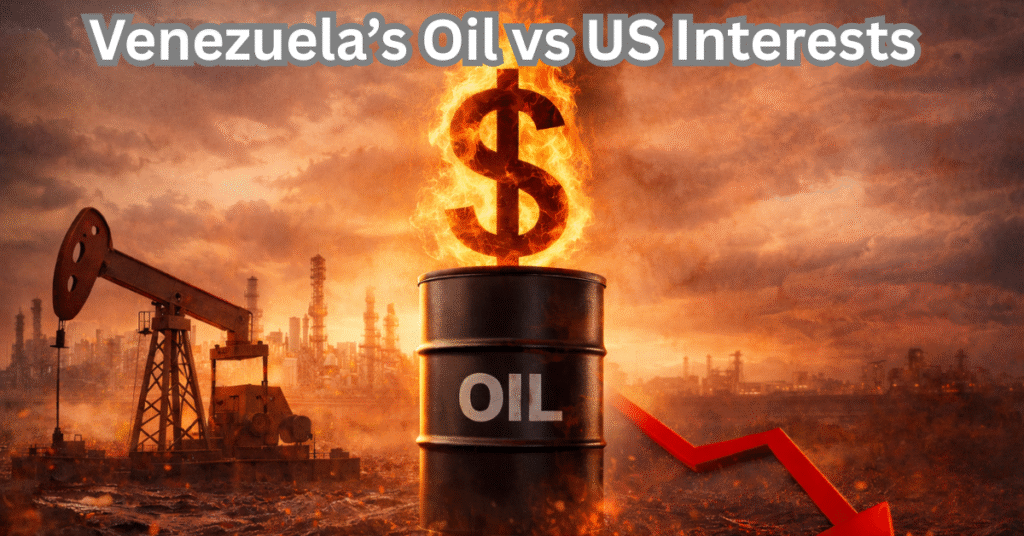
Venezuela’s vast petroleum reserves have long shaped not only its own political and economic destiny but also its relations with global powers — especially the United States. At the heart of the US–Venezuela conflict lies a tussle over energy resources, strategic influence, and economic leverage. With the world’s largest proven crude reserves, Venezuela’s oil has been both a blessing and a curse, attracting foreign interest while fueling deep geopolitical tension, particularly with Washington.
Why Venezuela’s Oil Matters Globally
Venezuela’s oil legacy dates back more than a century. Its reserves are among the richest in the world, with estimates suggesting the nation holds roughly 300 billion barrels of crude oil — nearly 17% of global proven reserves. These reserves are not only vast but strategically important, placing Venezuela among the most resource-rich nations on the planet.
Historically, Venezuela was a reliable exporter to the United States, sending millions of barrels of crude daily in the 1990s and early 2000s. American refineries along the Gulf Coast were configured to process Venezuela’s heavy, sour crude, making the partnership economically efficient and geopolitically significant.
Yet despite this natural advantage, Venezuela’s oil production has declined dramatically over the past few decades. Mismanagement, corruption, and a lack of investment have reduced output from more than 3 million barrels per day in the late 1990s to under 1 million barrels per day in recent years. This decline, combined with shifting global oil patterns, widened cracks in Venezuela’s economic foundation long before the current geopolitical standoff.
The Nationalisation That Changed Everything
Venezuela’s oil sector took a decisive turn in 1976 when the government nationalised foreign oil assets, culminating in full state control under the state-owned company Petróleos de Venezuela, S.A. (PDVSA). This drive for economic sovereignty continued under leaders like Hugo Chávez, who used oil revenue to fuel social programmes and assert Venezuela’s independence from foreign influence — especially from the U.S.
Although nationalisation was celebrated domestically as a reclaiming of resources once dominated by multinational firms, it set the stage for future tension with the United States. Expropriation of U.S. oil assets in Venezuela left a legacy of legal disputes and lingering resentment, and oil became enmeshed in ideological conflict between Caracas and Washington.
Also Read: – Why the United States Sanctioned Venezuela: A Complete Breakdown – lostnews
Sanctions, Blockades, and a Struggle Over Venezuela’s Oil Revenue
By the late 2010s, the relationship between the U.S. and Venezuela was deeply strained. A major flashpoint was the imposition of sanctions on Venezuela’s oil sector by Washington, designed to cripple the revenue streams that fuelled Nicolás Maduro’s government and to pressure Caracas toward political change.
The effects were severe: Venezuelan crude exports plummeted as risk-averse tankers and traders avoided the market to avoid U.S. penalties. The U.S. even blocked certain Venezuelan oil shipments, making it virtually impossible for state-run PDVSA to sell crude through normal global channels. This approach was often described by analysts and critics as a near-complete oil embargo or blockade.
As part of broader efforts to enforce these sanctions, the United States has seized oil tankers suspected of violating sanctions or attempting to carry Venezuelan crude to sanctioned markets. Such seizures underline how oil has become more than an economic asset — it has become a bargaining chip in a larger geopolitical power struggle.
Recent Policy Shifts and Renewed Venezuela’s Oil Deals
In early 2026, a significant pivot occurred. According to multiple sources, the United States began signalling a strategic engagement with Venezuela’s oil, including purchases of Venezuelan crude and plans to sell oil that had been previously blocked under sanctions. Estimates included the sale of up to 50 million barrels of oil to U.S. markets, with sanctions eased to allow these transactions.
These developments reflect a dramatic change: from isolating Venezuela’s petroleum industry to playing a direct role in managing its oil output and sales. The U.S. government publicly stated that future Venezuelan oil production would be overseen and marketed under its supervision, effectively inserting itself into decision-making over Venezuela’s primary export commodity.
While part of this strategy has been justified as a means to support Venezuela’s people, analysts see it as a broader assertion of U.S. influence in the Western Hemisphere’s energy landscape. Critics note that controlling Venezuela’s oil flows could reinforce U.S. leverage not only over Caracas but over global petroleum markets — a critical consideration in a world still heavily dependent on oil.
Economic Leverage and Strategic Benefits for the U.S.
There are multiple reasons why Venezuela’s oil remains a focus for the United States:
- Energy security: Access to Venezuelan crude gives U.S. refineries another feedstock, potentially reducing dependence on other foreign suppliers.
- Market influence: Controlling crude flows — or even influencing production levels — can help Washington in broader negotiations on oil prices and supply stability.
- Geopolitical leverage: In an era when Russia, China, and Iran have expanded their influence through energy partnerships, securing a role in Venezuela’s oil sector provides the U.S. with both economic and diplomatic advantages.
- Revenue streams: The sale of Venezuelan oil could generate significant revenue, which Washington has argued could be used to benefit both Americans and Venezuelans.
Challenges and Controversies
Despite these strategic motivations, the story is not straightforward. Venezuela’s oil infrastructure has deteriorated significantly, requiring billions in investment to restore and maintain production capacity. Analysts estimate that only a fraction of Venezuela’s massive reserves are currently extractable at economically viable rates without substantial rehabilitation.
Furthermore, the shift in U.S. policy has not been universally welcomed. Critics, including international partners and Venezuelan leaders, see these moves as infringements on national sovereignty and economic self-determination. China and Russia, both longtime allies of Caracas, have condemned U.S. actions and raised concerns about wider geopolitical implications.
Also Read: – The Roots of the US–Venezuela Conflict: How It All Started – lostnews
Conclusion
At its core, the US–Venezuela conflict over energy resources is not just about barrels of crude — it is about power, influence, and economic strategy in a world still shaped by oil. Venezuela’s oil endowment is enormous, and control over its production and sale has become a central point of strategic competition. As policies shift and new agreements emerge, the interplay between Venezuela’s petroleum wealth and U.S. interests will remain a defining feature of their complex relationship.





1 thought on “Venezuela’s Oil vs US Interests: The High-Stakes Power Struggle Shaping Global Energy Politics”