
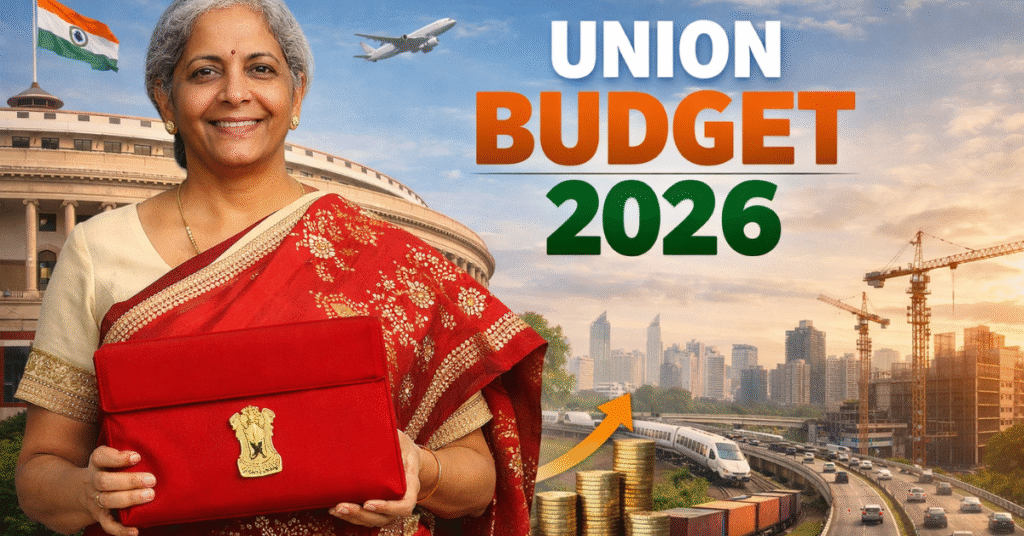
On 1 February 2026, India’s Finance Minister Nirmala Sitharaman presented the Union Budget for 2026–27 in Parliament — marking her ninth consecutive Budget presentation. The 2026 Budget sought to balance growth, fiscal discipline, and welfare, building on India’s ongoing economic transformation while addressing future challenges and opportunities.
In an era of shifting global economic conditions, this Budget focused on infrastructure investment, technology-led manufacturing, youth employment, health care, rural development, and fiscal stability. Emphasis was also placed on empowering citizens through skilling and entrepreneurship, especially in frontier sectors such as biotech, semiconductors, and green industries.
1. The Big Picture: Vision & Priorities
The Union Budget 2026-27 was built around a framework described as three “Kartavyas” (duties):
- Sustainable and inclusive economic growth
- Capacity building through skills, infrastructure, and credit
- Sabka Saath, Sabka Vikas (everyone’s support, everyone’s progress)
This framework reflects an attempt to achieve broad-based, resilient economic advancement.
The Finance Minister framed the Budget as a “calibrated balance between supporting growth and maintaining fiscal discipline,” pointing to disciplined spending alongside bold strategic initiatives.
2. Growth Through Infrastructure & Capital Spending
One of the most striking features of the 2026 Budget was the emphasis on public capital expenditure — the government’s spending on infrastructure that fuels economic growth.
Capital Expenditure Up — ₹12.2 Lakh Crore
The Budget proposed ₹12.2 lakh crore for public capital expenditure in FY 2026–27 — a jump from the previous year’s level — signalling continued focus on large-scale infrastructure projects.
Big Projects & Connectivity
Several landmark projects were announced, including:
- Seven new high-speed rail corridors connecting major Indian cities and economic hubs, reducing travel time and catalysing regional development.
- Expansion of National Waterways — with 20 new waterways planned to be operational in five years — to boost inland shipping, reduce logistics costs, and support riverside economic growth.
- Dedicated freight corridors and expanded rail and road networks to improve logistics efficiency.
These connectivity projects aren’t just about faster transport — they help unlock employment, goods movement, trade, and investment in smaller cities and rural belts.
Also Read: – Venezuela’s Oil vs US Interests: The High-Stakes Power Struggle Shaping Global Energy Politics – lostnews
Finance Commission Grants to States
The Budget allocated ₹1.4 lakh crore to states as Finance Commission grants, ensuring local bodies and disaster management systems are strengthened.
3. Manufacturing & Strategic Sectors: India’s Tech and Industrial Push
Capitalising on its demographic dividend and technological prowess, India sought to leap forward in manufacturing and strategic industries.
Biopharma Shakti: A Health-Tech Leap
The Biopharma Shakti initiative — with an allocation of ₹10,000 crore over five years — aims to make India a global bio-manufacturing hub, enhancing research, quality control, trials, and domestic production of advanced medicine.
This initiative includes:
- Creating a network of clinical trial sites
- Strengthening national institutes of pharmaceutical education
- Boosting production of critical drugs and biotech products
Such efforts can reduce import dependence and foster domestic health innovation and job creation.
Semiconductor Mission 2.0
Building upon earlier efforts, the government launched India Semiconductor Mission 2.0 — aimed at bolstering local manufacturing of semiconductors, equipment, and materials, strengthening supply chains, and fostering high-end tech jobs.
Electronics & Container Manufacturing
Outlays for electronics components manufacturing were lifted to ₹40,000 crore, and a ₹10,000 crore scheme for container manufacturing was announced to reduce import dependence while boosting manufacturing clusters.
Textiles & Industrial Revival
The Budget also framed new programmes for the textile sector — including mega parks, skill development, and global market outreach — underlining support for traditional industries and employment-intensive sectors.
4. Rural Development & Livelihoods
The Budget reinforced the government’s commitment to rural economies:
- Viksit Bharat-Guarantee for Rozgar Aajeevika Mission (VB-G RAM G) was allocated ₹95,692.31 crore, with a focus on rural employment and livelihoods.
- The Jal Jeevan Mission, aimed at providing reliable tap water in rural homes, received an increased outlay of ₹67,670 crore.
- The flagship MGNREGA programme was allocated ₹30,000 crore to support rural job creation.
These allocations reflect the continuing priority given to rural stability and inclusive growth.
5. Healthcare & Medical Tourism
Healthcare was a key area of focus, with multiple initiatives:
- Customs duty waived on 17 cancer drugs and medicines for seven rare diseases, lowering costs for critical treatments.
- Aimed at improving healthcare delivery and global competitiveness, regional medical hubs (including private partnerships) will be developed to support medical tourism.
- Training programmes for 1 lakh allied health professionals and 1.5 lakh multi-skilled caregivers were announced to address workforce shortages in healthcare.
6. Jobs, Skilling & Youth Empowerment
Recognising the importance of youth in driving India’s future, the Budget emphasised:
- AI, tech, and digital skills development
- Enhanced support for startups and MSMEs
- Tailored training initiatives in emerging sectors
- Tourism sector expansion, including the development of 15 archaeological sites as cultural destinations, creates jobs and boosts local economies.
7. Personal Taxation & Common Citizen Impact
For individuals and taxpayers, the Budget was moderate on direct tax relief:
- No change in personal income tax slabs or basic tax rates, but relief persists through existing structures (e.g., tax-free thresholds in the new regime around ₹12 lakh).
- TCS (Tax Collected at Source) on overseas tour packages was slashed from 5–20% to a flat 2%, helping international travellers and students.
- New exemptions — such as on interest from motor accident claims — and easier compliance rules were introduced to make tax filing smoother.
Meanwhile, updates to TDS and TCS norms aim to simplify compliance and ease the burden on small taxpayers and frequent filers.
Also Read: – Understanding the Impact of Tariffs and 401(k) Updates on Your Finances – lostnews
8. Fiscal Health & Discipline
The Budget projected a fiscal deficit target of 4.3% of GDP for FY 2026–27 — a gradual improvement from the previous year’s estimate — balanced against significant development spending.
Maintaining a disciplined fiscal stance was seen as key to investor confidence, inflation control, and stable credit ratings.
Conclusion: What the 2026 Budget Means for India
The Union Budget 2026–27, presented on 1 February 2026, was a blueprint for long-term economic resilience and inclusive growth. From infrastructure and manufacturing to health, rural welfare, and jobs, the Budget laid out a multi-pronged strategy tailored to opportunities and challenges in a rapidly evolving global economy.
For citizens, it indicates a future that values not just GDP growth, but also quality of life, job creation, and skill building. For industries, especially in tech, manufacturing, biotech, and MSMEs, the Budget offered policy certainty, incentives, and strategic direction.
While some observers highlight missed expectations on dramatic tax cuts for the middle class, the overall thrust remains on reform, investment, and capability building — essential for India’s march towards becoming a global economic leader in the decade ahead.





2 thoughts on “Union Budget 2026-27: A Big Vision for Growth, Jobs & Inclusive Progress”