
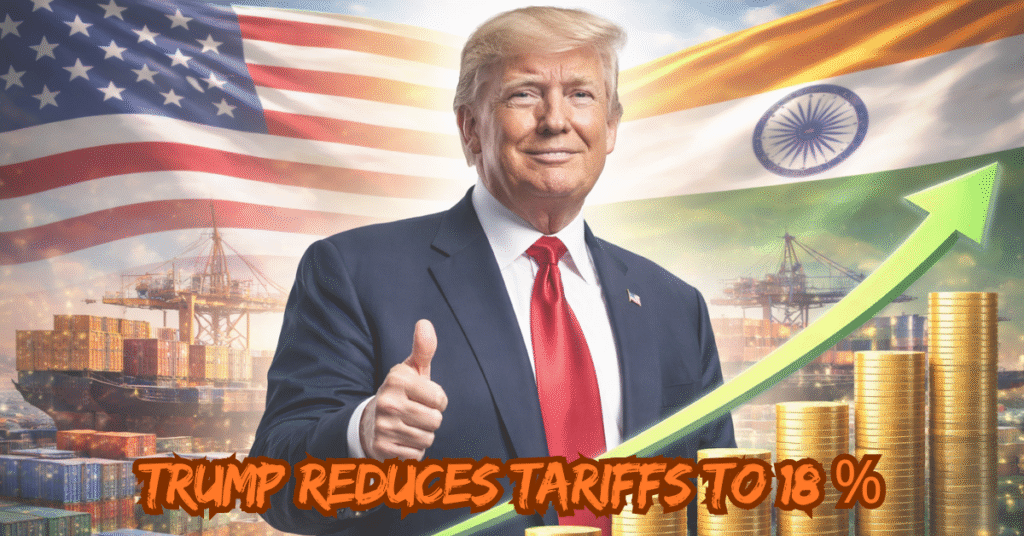
On 2 February 2026, U.S. President Donald Trump announced a major change in tariff policy toward India — cutting the tax on Indian exports entering the United States to 18%. This move came after Prime Minister Narendra Modi agreed to end India’s purchases of Russian oil and pledged increased purchases of U.S. products.
This is a big development in what has been a tense trade relationship between the two countries. It potentially affects Indian businesses, exporters, consumers, and the wider Indian economy. In this article, we’ll break it down simply: what has changed, why it matters, and how it could shape India’s growth in the coming years.
1. What Are Tariffs? A Simple Explanation
Tariffs are taxes that a government imposes on goods imported from another country. When a foreign company sells something in the U.S., the U.S. imposes a tariff—like a tax — that makes that product more expensive than local American products. Tariffs are used for many reasons:
- To protect local industries
- To reduce trade deficits
- To influence foreign policy
- To encourage or discourage specific trading behaviour
Lower tariffs generally make imported goods cheaper and help exporters sell more. Higher tariffs make imports more expensive, often reducing demand.
2. What Was the Tariff Before? How Big Was the Change?
Before the new 18 % tariff announced in February 2026, the tariff structure between the U.S. and India went through several stages:
a. Before Late 2024
India and the U.S had relatively normal tariff levels, with the U.S. imposing modest duties on Indian exports and India having its own tariff structure on U.S. goods.
b. Mid-2025: Dramatic Tariff Hikes
In August 2025, Washington imposed punitive tariffs on Indian exports, reaching as high as 50%. This included:
- A 25 % tariff on Indian goods
- An additional 25 % penalty tariff tied to India’s purchases of Russian oil
These tariffs were among the highest in U.S. trade policy and sharply raised costs for Indian exporters selling to the U.S. market. Economists warned that such high tariffs could make Indian products so expensive that U.S. buyers might switch to cheaper competitors, such as Vietnam or Bangladesh.
c. The New Deal: 18 % Tariff
Under the new 2026 agreement:
- The punitive tariffs are rolled back
- The U.S. will charge a fixed 18 % tariff on Indian goods entering the U.S.
- In return, India agreed to stop importing Russian crude oil and to reduce tariffs on U.S. goods to zero
- India also committed to purchasing a large amount — potentially $500 billion — of U.S. energy, technology, and other goods over time
In simple terms, the tariff on Indian exports has gone from very high and punitive (up to 50 %) to moderate and predictable (18 %). This shift alone changes the economic incentives for both exporters and importers.
Also Read: – Union Budget 2026-27: A Big Vision for Growth, Jobs & Inclusive Progress – lostnews
3. Why This Change Happened
This tariff reduction did not occur in isolation. Several factors contributed to it:
a. Trade and Strategic Negotiations
The U.S. has been pushing India to reduce its reliance on Russian oil due to global geopolitical tensions, especially the Russia-Ukraine conflict. India’s rising purchases of discounted Russian crude had angered U.S. policymakers, prompting punitive tariffs intended to pressure India.
b. Bilateral Trade Goals
Both India and the U.S. have long expressed interest in expanding trade, with ambitious goals like increasing bilateral trade values to $500 billion by 2030. High tariffs were a roadblock to that vision.
c. Balance of Trade and Political Signals
Reducing tariffs also acts as a political signal: it promotes cooperation, eases tensions, and sends a message that both economies want trade relations that benefit businesses and consumers on both sides.
4. What This Means for Indian Exporters
The drop to 18 % is largely being welcomed by Indian exporters. Here’s why:
a. Higher Competitiveness
Many Indian products were priced out of the U.S. market when tariffs were raised to punitive levels. With tariffs now at only 18 %, Indian goods become more affordable for American consumers.
b. Release of Deferred Orders
Businesses that had delayed accepting orders due to high export costs may now restart trade flows. Labour-intensive sectors like textiles, apparel, leather goods, and footwear are especially expected to benefit.
c. Stable Business Environment
A predictable tariff — rather than unpredictable punitive measures — means exporters can plan their production, pricing, and market strategies better.
5. Possible Impact on India’s Economic Growth
Predicting exact economic growth outcomes is complex, but experts see several clear trends:
a. Boost to Exports
Exports to the U.S. could increase due to lower tariffs. The U.S. is one of India’s biggest markets, absorbing a sizeable share of Indian products like textiles, gems, electronics, and agricultural goods. Lower tariffs provide a big incentive to expand export volumes.
b. Support for Jobs and Industries
Large export-oriented sectors employ millions of workers. Reviving trade with the U.S. could help protect jobs and encourage investment in manufacturing and exports.
c. Influence on GDP Growth
Economists earlier estimated that extremely high tariffs in 2025 could shave growth by 0.3–1.1 % due to reduced exports and supply disruption risks. With tariffs now back at 18 %, this drag on GDP growth could be reduced or reversed, helping India stay on its course as one of the fastest-growing major economies.
d. Consumer and Market Confidence
Lower trade friction and a clear trade path tend to build investor confidence, which can boost stock markets, corporate investments, and foreign direct investment (FDI).
6. Broader Economic and Strategic Impacts
a. Strengthening U.S.-India Relations
This tariff rollback could signal deeper economic cooperation beyond trade — including defence, energy, and technology partnerships.
b. Global Trade Position
India’s global trade position may strengthen if exporters regain competitiveness in a major market like the U.S. This could encourage new trade deals with other regions.
c. Import-Export Balance
Even though tariffs for U.S. goods have been lowered to zero in this deal, India must carefully manage its domestic industries to ensure local manufacturers aren’t overwhelmed by cheaper imports.
Also Read: – Explained: U.S. 50% Tariffs on Indian Exports and What It Means for You – lostnews
7. What Could Still Go Wrong?
No deal is risk-free. Some economists warn:
- Certain Indian industries could face competition from U.S. imports once tariffs on U.S. goods go to zero
- Global market shocks — like changes in oil prices or other tariffs worldwide — can still disrupt growth projections
However, overall, the tariff reduction to 18% provides a framework for stable, long-term trade benefits.
8. Final Thoughts: A Step Toward Growth
The leap from punitive, unpredictable tariffs to a structured 18 % tariff represents a significant shift in India-U.S. trade policy. It eases pressure on Indian exporters, increases business confidence, and sends positive signals for India’s economic growth.
While tariff changes alone won’t solve all trade challenges, this move can:
✔ Reignite export growth
✔ Support jobs in key sectors
✔ Improve investor and market confidence
✔ Strengthen India’s position as a global exporter
This policy change could prove a turning point in how India engages with major trading partners, especially as global trade patterns and geopolitics rapidly evolve.




1 thought on “Trump Reduces Tariffs to 18%: What It Means for India’s Economy”