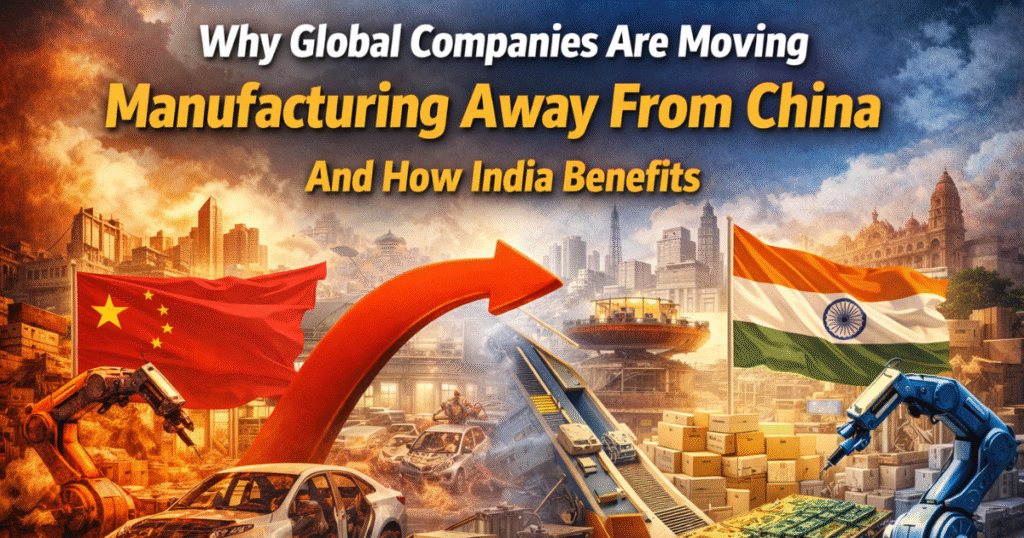
For more than two decades, China was known as the “factory of the world.” From smartphones and toys to machinery and electronics, almost everything seemed to come with a “Made in China” tag. Global companies loved China because it was cheap, fast, and efficient.
But things are changing.
Over the last few years, many major multinational companies have quietly reduced their dependence on China. Some are moving parts of their factories to other countries, while others are planning long-term exits. This shift is slow, cautious, and strategic — but it is very real.
And in this global reshuffling, India is emerging as one of the biggest beneficiaries.
Let’s understand why companies are moving away from China, what geopolitics has to do with it, and how India stands to gain in the coming years.
China’s Long Run as the World’s Factory
China didn’t become a manufacturing giant overnight. Its rise was built on:
- Very low labour costs
- Strong government support
- Massive infrastructure investment
- Easy access to ports and supply chains
Western companies outsourced production to China to reduce costs and increase profits. Over time, China built an ecosystem where raw materials, components, factories, and shipping networks worked smoothly together.
But this same success has now created new challenges.
1. Rising Costs Are Eating Into Profits
Labour Is No Longer Cheap
China is no longer a low-wage country. As living standards improved, wages increased sharply. Factory workers now demand better pay, housing, and social security benefits.
For global companies, this means:
- Higher production costs
- Lower profit margins
- Reduced price competitiveness
Many companies realised that what once made China attractive is slowly disappearing.
2. US–China Tensions Changed the Game
Trade Wars and Tariffs
The US–China trade war sent a strong message to global businesses:
Depending on one country is risky.
Tariffs increased the cost of Chinese-made goods entering Western markets. Even companies that were not directly involved began to feel nervous.
This wasn’t just about trade — it was about power, technology, and global influence.
Technology Restrictions
Restrictions on advanced technology, semiconductors, and data security led companies to rethink where they place their most critical manufacturing facilities.
Many firms realised:
- Political decisions can disrupt business overnight.
- Governments can block supply chains.
- Manufacturing has become a geopolitical issue.
Also Read: – Trump Reduces Tariffs to 18%: What It Means for India’s Economy – lostnews
3. COVID-19 Exposed Dangerous Supply Chain Weaknesses
The pandemic was a wake-up call.
When China shut down factories during lockdowns:
- Global production stopped
- Shortages hit markets worldwide.
- Companies couldn’t meet demand.
From cars to smartphones, delays caused massive losses.
This led to a new business philosophy:
“Don’t put all your eggs in one basket.”
Companies began searching for alternative manufacturing hubs to reduce future risks.
4. Growing Geopolitical Uncertainty Around China
China’s relations with several countries have become tense in recent years. Issues related to:
- Taiwan
- South China Sea
- Human rights concerns
- Cybersecurity
…have made investors cautious.
Businesses prefer stable, predictable environments. When political uncertainty increases, companies naturally look for safer options.
5. Why Companies Are Choosing a ‘China Plus One’ Strategy
Instead of exiting China completely, most companies are adopting a China Plus One strategy.
This means:
- Keep some production in China.
- Shift new investments to other countries.
- Build backup supply chains.
Popular alternatives include:
- India
- Vietnam
- Indonesia
- Mexico
Among these, India stands out for several reasons.
Why India Is Emerging as a Strong Alternative
1. Large and Skilled Workforce
India has:
- One of the world’s youngest populations
- Millions of engineers and technicians
- A growing manufacturing talent pool
This makes India attractive for industries like:
- Electronics
- Automobiles
- Pharmaceuticals
- Renewable energy
2. Government Push for Manufacturing
India has actively encouraged manufacturing through:
- Production Linked Incentive (PLI) schemes
- Ease of Doing Business reforms
- Infrastructure development
- Tax incentives for global companies
These policies send a clear message:
India wants to become a global manufacturing hub.
3. Strong Domestic Market
India is not just a manufacturing base — it is also a massive consumer market.
Companies see a big advantage:
- Manufacture in India
- Sell to Indians
- Export globally
This dual opportunity reduces risk and increases long-term profitability.
4. Improving Infrastructure
India has invested heavily in:
- Highways and expressways
- Ports and logistics
- Industrial corridors
- Dedicated freight routes
While challenges remain, the direction is clearly positive.
Sectors Where India Is Benefiting the Most
Electronics and Smartphones
Major smartphone brands are expanding production in India. Local assembly has turned into deeper manufacturing, creating thousands of jobs.
Automobiles and EVs
India is becoming a hub for:
- Auto components
- Electric vehicles
- Battery manufacturing
Pharmaceuticals
India is already known as the “pharmacy of the world.” Now companies are strengthening local supply chains for critical medicines.
Defence and Aerospace
Rising geopolitical tensions have increased demand for domestic defence manufacturing, creating new opportunities.
Job Creation and Economic Growth
As factories shift to India:
- Employment opportunities increase
- Skill development improves
- Local economies grow
Manufacturing growth supports:
- MSMEs
- Logistics companies
- Service industries
This creates a multiplier effect across the economy.
Challenges India Still Needs to Overcome
Despite the opportunities, India faces challenges:
- Land acquisition delays
- Regulatory complexity
- Skill gaps in advanced manufacturing
- Power and logistics costs in some regions
However, awareness of these issues is growing, and reforms are ongoing.
What This Means for Indian Businesses and Investors
For Businesses
Indian suppliers and manufacturers can:
- Enter global supply chains.
- Upgrade technology
- Expand exports
For Investors
Manufacturing-focused sectors may see long-term growth:
- Industrial stocks
- Infrastructure companies
- Logistics firms
- Auto and electronics suppliers
This shift is structural, not temporary.
Also Read: – What Makes China a Beast in Tech Manufacturing? – lostnews
The Bigger Geopolitical Picture
Manufacturing is no longer just about cost. It is about:
- National security
- Economic independence
- Political alliances
Countries want supply chains they can trust.
India’s neutral yet strategic global position makes it an attractive partner.
Final Thoughts: A Rare Opportunity for India
The world is witnessing a slow but powerful transformation. As companies reduce their dependence on China, India has a once-in-a-generation chance to become a major manufacturing powerhouse.
This won’t happen overnight. It requires consistent policy support, infrastructure growth, and private investment. But the momentum is real.
For India, this shift means:
- More jobs
- Stronger economy
- Greater global influence
And for global companies, it means safer, more diversified supply chains.
The factory of the future may no longer belong to just one country — and India is ready to claim its share.