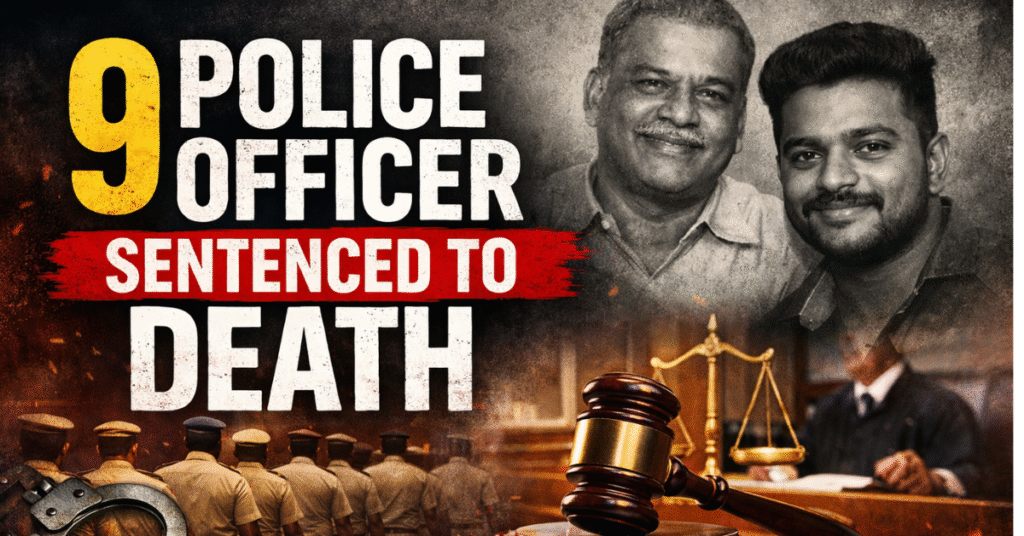
India has been gripped by the chilling news: 9 police officers have been sentenced to death, spotlighting the tragic and highly controversial Sathankulam custodial deaths case.
This case is not just about a legal verdict. It is about justice, accountability, and the responsibilities that come with power. The incident, which took place in 2020, continues to influence conversations around police conduct and human rights in India.
This article examines what happened, the investigation, court findings, and the significance of 9 police officers receiving the death sentence in India’s legal history.
The Beginning: A Small Incident That Turned Tragic
In June 2020, during strict COVID-19 lockdown rules in Tamil Nadu, a father and son — P. Jeyaraj and J. Bennix — were picked up by local police in Sathankulam.
Why Were They Detained?
- They owned a small mobile shop.
- The shop was reportedly open beyond permitted hours.
- Police detained them for violating lockdown guidelines.
What appeared to be a minor violation soon escalated into a tragic incident that would shock the entire nation.
What Happened in Custody?

As per investigation records and witness testimonies:
- The victims were subjected to severe custodial violence.
- They suffered multiple injuries due to physical assault.
- Proper medical attention was allegedly not provided on time.
Despite their condition, they were sent to judicial custody. Within days:
- Jeyaraj passed away
- Bennix also lost his life shortly after
Their deaths triggered outrage and demands for strict action.
Public Outrage and National Attention
The incident quickly gained nationwide attention:
- Social media campaigns demanded justice.
- Citizens, activists, and public figures spoke out.
- The case became a symbol of concern over custodial violence in India.
Due to mounting pressure, the case was transferred to the Central Bureau of Investigation (CBI).
Investigation and Charges
The CBI investigation revealed serious findings:
- Evidence of intentional physical assault
- Medical reports confirming internal injuries
- Witness accounts pointing towards abuse of power.
- Attempts to alter or hide evidence
Initially, 10 police personnel were accused.
However:
- One accused officer died due to COVID-19 during the early phase of the case.
- The trial continued against the remaining 9 officers.
Historic Verdict: 9 Police Officers Sentenced to Death
In April 2026, the court delivered a landmark judgment:
9 police officers sentenced to death after being found guilty of murder.
This decision is considered one of the strongest actions taken by an Indian court against custodial violence involving law enforcement officers.
Judge’s Statement: What the Court Said
The judge, while delivering the verdict, made strong observations about the nature of the crime and the responsibility of those involved.
Key Points from the Judgment (Simplified and Respectful Summary)
- The court described the act as extremely brutal and inhuman.
- It noted that the victims were in police custody and completely vulnerable.
- The accused were public servants entrusted with protecting citizens, not harming them.
- The actions of the officers were seen as a serious misuse of authority and power.
On the Death Penalty
The judge stated that:
The case falls under the category of the “rarest of rare”, where the severity of the crime and the breach of trust justify the highest punishment under law.
The court also emphasised that:
- Custodial violence damages the foundation of justice.
- Such acts cannot be tolerated in a democratic system.
- Strong punishment is necessary to maintain public confidence in law enforcement.
Legal Basis: “Rarest of Rare” Doctrine
The judgment followed the legal principle established in Bachan Singh vs State of Punjab, which allows the death penalty only in exceptional cases.
In this case, the court found that:
- The crime was exceptionally grave.
- The victims had no chance to defend themselves.
- The accused violated the trust placed in them as law enforcers.
Also Read:- ABG Shipyard Bank Fraud (2022): Inside India’s Biggest Ever Loan Scam – lostnews
Public Reaction to “9 Police Officers Sentenced to Death.”
The verdict led to mixed reactions:
Supporters Said:
- Justice was finally delivered.
- It sent a strong message against abuse of power.
- It may help prevent future custodial violence.
Others Felt:
- The death penalty may not solve systemic issues.
- Reforms in policing are equally important.
- There should be a focus on prevention, not just punishment.
What Happens Next?
Even though 9 police officers sentenced to death is a major verdict, the legal process is still ongoing.
Next Steps Include:
- Appeals in higher courts
- Review by the High Court and possibly the Supreme Court
- Final decision after multiple legal stages
In India, death sentences are subject to strict judicial review before implementation.
Why This Case Will Be Remembered
The Sathankulam custodial deaths case has left a deep impact on Indian society:
- It highlighted the issue of custodial violence.
- It reinforced the importance of accountability.
- It reminded institutions of their responsibilities.
Most importantly, it showed that:
No individual is above the law, regardless of their position.
Conclusion
The case behind the headline “9 police officers sentenced to death” is not just about punishment. It is about justice, responsibility, and the protection of human dignity.
While the verdict marks a significant legal step, it also reminds us that:
- Systems must improve
- Trust must be rebuilt.
- And such incidents must never happen again.