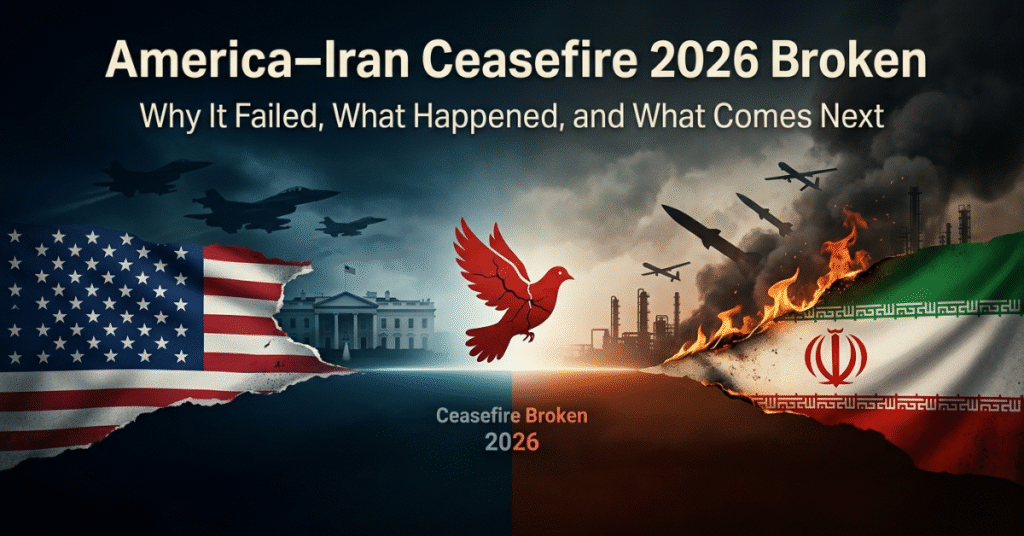
The America–Iran Ceasefire 2026 was supposed to be a turning point in one of the most dangerous global conflicts in recent years. After nearly 40 days of intense fighting, missile attacks, and rising global fear, the ceasefire offered hope.
But that hope didn’t last long.
Within 24 to 48 hours, signs emerged that the ceasefire was already breaking down. What was announced as a two-week truce quickly turned into confusion, accusations, and renewed tension.
So what exactly happened?
Why did the ceasefire fail so quickly?
Who broke it first?
And what does it mean for the world?
Let’s break it down in a simple, clear, and human-friendly way.
After How Many Hours Was the Ceasefire Broken?
The ceasefire was officially announced on April 8, 2026.
However:
- Reports suggest violations began within hours of the agreement.
- Within less than 24 hours, tensions had already escalated again.
- Within 48 hours, the ceasefire was widely seen as fragile or on the verge of collapse.
In fact, some early reports even indicated incidents happening just hours after the truce, including strikes and drone activity.
Conclusion:
The ceasefire did not even hold for a full day before cracks began to appear.
What Exactly Happened After the Ceasefire?
Instead of calm, the situation quickly turned chaotic.
Key Events That Broke the Ceasefire:
- Airstrikes continued in Lebanon, linked to Israel’s operations.
- A drone entered Iranian airspace, raising tensions.
- Iran claimed its nuclear rights were being ignored.
- Missile and military movements continued in the region.
According to reports, Iran even accused the United States of violating the agreement almost immediately.
At the same time, Israel launched large-scale strikes, further destabilising the situation.
Also Read:- America–Iran Ceasefire 2026: A Temporary Pause or the Start of a New Chapter? – lostnews
Why the Ceasefire Was Broken
The collapse of the America–Iran Ceasefire 2026 was not caused by just one factor. Instead, multiple deep-rooted issues led to its failure.
1. Lack of Clear Agreement
One of the biggest problems was that both sides had different understandings of the ceasefire.
- Iran believed certain demands were accepted.
- The U.S. did not fully confirm those terms.
- Key points were never officially clarified.
This created confusion from the very beginning.
Result:
Both sides accused each other of violating a deal that was never fully agreed upon.
2. Israel Factor – The Biggest Trigger
The involvement of Israel played a major role in breaking the ceasefire.
- Israel continued strikes in Lebanon.
- It claimed the ceasefire did not include its operations in Lebanon.
- Iran saw this as a violation of the agreement.
This created a major conflict:
Iran’s view:
The ceasefire should include all allied forces
U.S./Israel view:
Ceasefire applies only to the U.S.–Iran
This disagreement became one of the main reasons for the breakdown.
3. Ongoing Military Actions
Even after the ceasefire announcement:
- Missile threats continued.
- Drone activities were reported.
- Military forces remained on high alert.
In one case, a drone incident inside Iran escalated tensions further.
This shows the ceasefire existed more on paper than on the ground.
4. Deep Trust Issues
The United States and Iran have a long history of mistrust.
- Previous agreements have failed.
- Both sides doubt each other’s intentions.
- Each side expects the other to break the deal.
Result:
Even small incidents quickly turned into major accusations.
5. Nuclear Disagreement
The nuclear issue remains the biggest point of conflict.
- The U.S. wants strict limits on Iran’s nuclear program.
- Iran refuses to give up its enrichment rights.
This disagreement was not resolved before the ceasefire, making the deal weak from the start.
6. Strait of Hormuz Tension
The Strait of Hormuz played a huge role in the conflict.
- Iran agreed to reopen it.
- But shipping remained restricted.
- Oil movement did not fully resume.
Even after the ceasefire, global shipping remained disrupted, indicating that tensions remained high.
This indicated the ceasefire was not being fully implemented.
7. Political Messaging & “Victory Claims.”
Another major reason for the breakdown was the political narrative.
- The U.S. claimed success in military objectives.
- Iran declared the ceasefire a victory.
- Both sides tried to appear strong.
When both sides claim victory, it usually means:
- No real compromise has been reached.
- Conflict is only temporarily paused
How the Ceasefire Collapsed Step-by-Step
Let’s simplify the sequence:
- Ceasefire announced (April 8, 2026)
- Within hours → Reports of violations
- Same day → Drone incidents & strikes
- Within 24 hours → Accusations begin.
- Within 48 hours → Ceasefire seen as unstable.
👉 Final Result:
A ceasefire that was meant to last 2 weeks struggled to survive even 2 days.
Global Impact of the Broken Ceasefire
The breakdown of the America–Iran ceasefire 2026 had immediate global consequences.
Oil Prices & Energy Crisis
- Oil supply routes remained uncertain.
- Prices stayed high
- Shipping delays continued
This affects countries like India directly through fuel prices.
Financial Market Uncertainty
- Markets became volatile again.
- Investors lost confidence
- The risk of inflation increased.
Risk of Full-Scale War Returns
The biggest fear is back:
A regional war involving multiple countries
With tensions rising again, the situation remains extremely dangerous.
What Happens Next?
After the ceasefire breakdown, three major scenarios are possible:
1. Renewed Talks
Diplomatic negotiations may restart, possibly through mediators like Pakistan.
2. Limited Conflict Continues
Small-scale attacks and tensions may continue without full war.
3. Full War Resumes
If tensions escalate further, a major war could begin again.
Also Read:- Middle East on Edge: What Happened in the Last 24 Hours? – lostnews
Final Conclusion
The America–Iran Ceasefire 2026 was a powerful reminder of how fragile peace can be in modern geopolitics.
It lasted:
Only a few hours to less than 48 hours before serious cracks appeared
The reasons behind its failure were clear:
- Lack of a clear agreement
- Involvement of Israel
- Ongoing military actions
- Deep mistrust
- Unresolved nuclear and political issues
In simple terms:
The ceasefire failed because the conflict itself was never truly resolved.
Final Thought
The world got a brief moment of hope — but it wasn’t enough.
Until the core issues between the United States and Iran are solved, any ceasefire will remain temporary.
For now, the situation remains uncertain — and the world continues to watch closely.