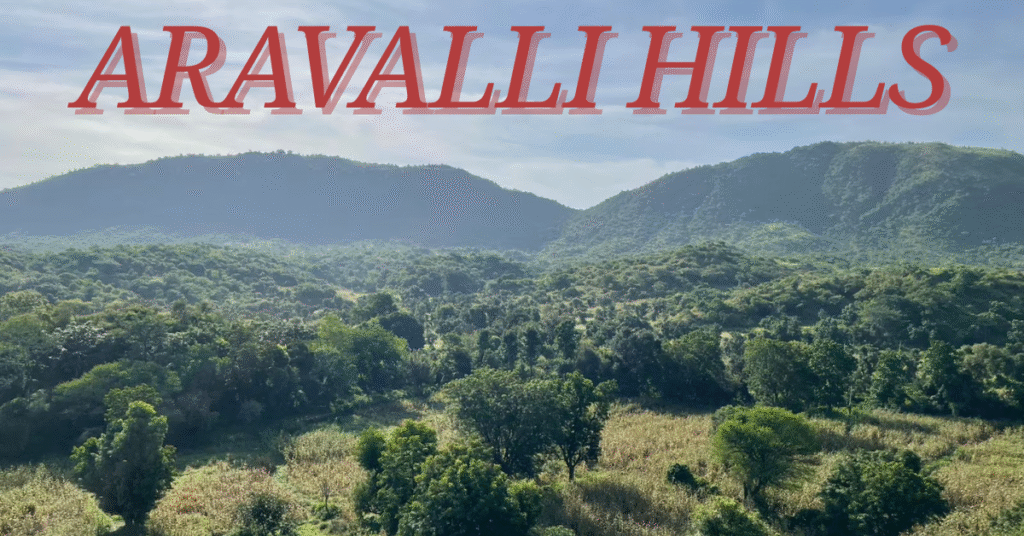
India’s ancient Aravalli hills, one of the oldest mountain ranges on Earth, have once again become the focus of nationwide attention. This time, it is not because of their historical or geological importance, but due to a controversial new definition approved by the Supreme Court following recommendations from the central government. The decision has triggered widespread protests across northern India, with environmentalists, farmers, residents, and opposition leaders warning of long-term ecological damage.
Stretching across Rajasthan, Haryana, Gujarat, and parts of Delhi, the Aravalli range acts as a natural barrier against desertification, protects groundwater reserves, and plays a critical role in controlling pollution levels in the National Capital Region (NCR). Many fear that the new definition could weaken protections for large parts of this fragile ecosystem.
What Has Changed in the Definition of Aravalli Hills?
Under the newly accepted framework, an Aravalli hill is defined as any landform that rises at least 100 metres above the surrounding terrain. Additionally, two or more such hills located within 500 metres of each other, along with the land between them, will be officially considered part of the Aravalli range.
The government argues that this definition brings clarity and consistency, especially for regulating mining activities across different states. However, environmental groups believe this technical classification could leave many low-lying, scrub-covered hills outside legal protection — despite their ecological importance.
Why Are People Protesting?
Protests have erupted in cities like Gurugram, Udaipur, Jaipur, and parts of Delhi, with people holding placards reading “Save Aravalli” and “Delhi Is Choking.” Demonstrations have largely remained peaceful but emotionally charged, reflecting public anxiety about the future of the region.
According to environmental activists, many parts of the Aravalli system do not meet the 100-metre height requirement but still play a crucial role in groundwater recharge, climate regulation, biodiversity protection, and preventing the spread of the Thar Desert.
Neelam Ahluwalia, a founding member of the advocacy group People for Aravallis, has warned that focusing only on elevation ignores the real purpose of environmental conservation.
“The Aravallis are not just hills; they are a living system that protects livelihoods, agriculture, and water sources in northwest India,” she said.
Also Read:- PoK Protests Shake Islamabad: 25-Point Agreement Reached After Violent Crackdown – lostnews
Ecological Importance Beyond Height
Experts argue that ecosystems should not be judged by height alone. Many of the Aravalli’s lower hills are covered with shrubs, grasses, and native vegetation that hold soil together, absorb rainwater, and support wildlife corridors.
Environmental activist Vikrant Tongad has pointed out that globally, mountain and hill systems are identified by their geological origin and ecological function, not arbitrary measurements.
“If a landform is part of the Aravalli geology and helps prevent desertification or supports biodiversity, it should be protected — regardless of how tall it is,” he explained.
Activists fear that excluding these areas could open the door to increased mining, construction projects, and commercial development, especially near fast-growing urban centres like Gurugram and Faridabad.
What Is the Government’s Stand?
The central government has attempted to reassure citizens that environmental protections will not be diluted. According to the environment ministry, the revised definition was created to strengthen regulation, not weaken it.
Officials say that:
- Mining will remain banned in protected forests, eco-sensitive zones, wetlands, and other inviolate areas.
- New mining leases will not be granted within officially defined Aravalli hills or ranges.
- Existing mining operations can continue only if they follow strict sustainable mining norms.
- Only certain strategic or atomic minerals, allowed under existing laws, may be extracted in specific cases.
Environment Minister Bhupender Yadav has stated that only about 2% of the total 147,000 square kilometre Aravalli region could even be considered for mining — and that too after detailed environmental studies and official approvals.
Why Concerns Still Remain
Despite these assurances, many environmental groups remain unconvinced. They argue that once land falls outside the legal definition of the Aravalli range, it becomes far more vulnerable to gradual encroachment, real estate projects, and unregulated development.
Activist groups have announced that protests will continue and that they are exploring legal options to challenge the revised definition. Some are also calling for the creation of a scientifically-backed, independent environmental assessment that considers geology, biodiversity, climate resilience, and water systems — not just height.
Also Read: – Nepal Protests 2025: Why Gen Z Took to the Streets Against Corruption and Censorship
A Larger Debate About Development vs Environment
The controversy highlights a broader national dilemma: how to balance economic growth with environmental protection. As cities expand and demand for minerals increases, pressure on natural ecosystems continues to rise.
For many Indians, the Aravalli hills are not just ancient rocks — they are a shield against pollution, water scarcity, and desertification. The outcome of this debate could shape the environmental future of northern India for decades to come.
Disclaimer
If any information in this article is found to be incorrect or unintentionally hurts the sentiments of any individual or community, I sincerely apologise. I am open to corrections and will gladly revise the content if needed.