When a war breaks out in a country thousands of kilometres away, most Indians instinctively ask one question:
“Why should this affect us?”
After all, daily life in India continues as usual — offices open, trains run, markets stay busy. Yet within days, or even hours, of global tensions rising, petrol prices start trending in news headlines, gold rates shoot up, and the stock market turns shaky.
This is not a coincidence.
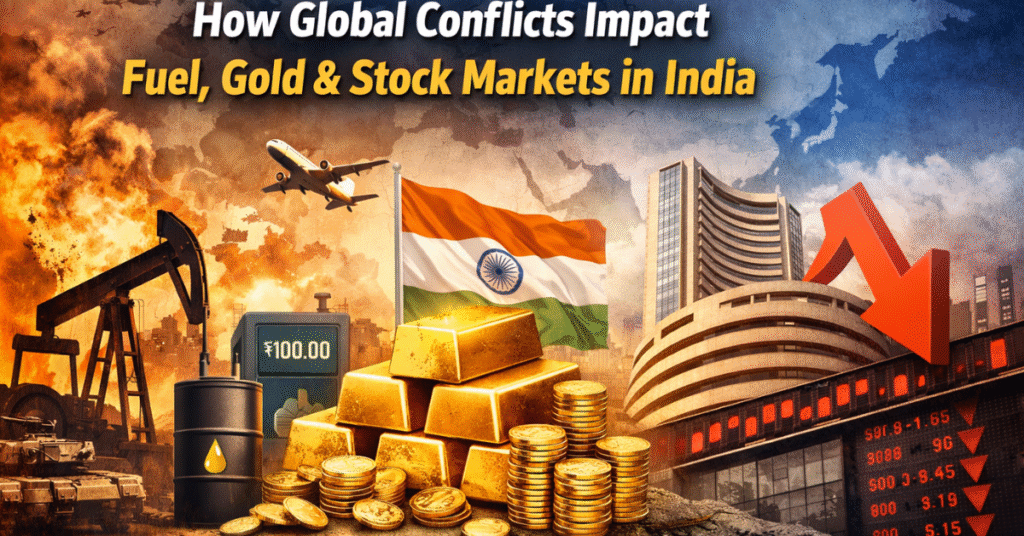
In today’s connected world, global conflicts quietly influence India’s fuel prices, gold demand, and stock market movements, even when the fighting is far from our borders. Understanding this connection is important — not just for investors, but for anyone managing household expenses, savings, or plans.
Let’s break this down in a simple, practical, and real-life way.
The World Is More Connected Than We Think
India does not live in isolation. Our economy is deeply connected to global trade, energy supply chains, financial markets, and foreign investments.
- India imports over 85% of its crude oil.
- International benchmarks set gold prices in India.
- Foreign investors play a major role in Indian stock markets.
When conflicts disrupt the global system, their effects reach Indian households faster than expected.
1. How Global Conflicts Impact Fuel Prices in India
Why Oil Is Always the First to React
Oil is the world’s most sensitive commodity. The moment there is conflict in oil-producing or oil-route regions, prices start moving.
Key conflict zones that affect oil:
- Middle East (Iran, Iraq, Israel, Saudi Arabia)
- Russia–Ukraine region
- Red Sea shipping routes
- Strait of Hormuz (through which nearly 20% of global oil passes)
Even fear of supply disruption is enough to push prices up.
What Happens Step by Step
- Conflict news breaks
- Traders fear that the oil supply may be reduced.
- Global crude prices rise instantly.
- India imports oil at higher rates.
- Fuel companies face higher costs.
- Petrol and diesel prices feel pressure.
Even if India buys oil from alternative sources, the global price benchmark still affects us.
Why Prices Don’t Fall Quickly After Peace
Many people wonder:
“If oil prices fall globally, why don’t fuel prices drop immediately in India?”
Reasons include:
- Government taxes
- Oil marketing company margins
- Rupee-dollar exchange rate
- Past losses are being recovered.
So global conflicts create fast price rises but slow relief.
Also Read: – Trump Reduces Tariffs to 18%: What It Means for India’s Economy – lostnews
2. Why Gold Becomes Everyone’s Favourite During Global Tensions
Whenever the world feels unsafe, gold becomes the hero.
Gold = Safety Asset
Gold is called a “safe haven” because:
- It does not depend on governments.
- It holds value during crises.
- It protects against currency weakness.
During wars or geopolitical tensions:
- Investors sell risky assets.
- Money moves into gold.
- Prices rise globally
India, being one of the largest gold consumers, feels this impact immediately.
Emotional Connection Matters Too
In India, gold is not just an investment:
- It’s part of weddings.
- Family savings
- Cultural security
When uncertainty rises, families instinctively trust gold more than paper assets.
Rupee vs Dollar Effect
Global conflicts often strengthen the US dollar. When the dollar rises:
- The rupee weakens
- Gold imports become costlier.
- Indian gold prices rise further.
This is why gold prices in India sometimes rise even more sharply than global prices.
3. Stock Markets: Where Fear Moves Faster Than Facts
Why Markets Hate Uncertainty
Stock markets don’t like surprises. Wars and global conflicts bring:
- Policy uncertainty
- Trade disruptions
- Rising costs
- Inflation fears
Even rumours can cause markets to fall.
How Indian Markets React
When global conflicts intensify:
- Foreign investors pull money from emerging markets.
- FIIs (Foreign Institutional Investors) sell Indian stocks.
- Markets become volatile
- Indexes fall suddenly
This doesn’t always mean Indian companies are weak. It’s often just global money moving to safety.
Which Sectors Get Hit First
Sectors most affected:
- Aviation (higher fuel costs)
- FMCG (input cost inflation)
- Auto (transport and raw material costs)
- IT (if global clients slow spending)
Sectors that sometimes benefit:
- Defence
- Energy producers
- Gold-related companies
4. The Hidden Role of Shipping Routes and Trade
Many people focus only on oil-producing countries, but shipping routes matter just as much.
Why Shipping Disruptions Are Dangerous
Global conflicts often block or threaten:
- Red Sea routes
- Suez Canal
- Black Sea
- Strait of Hormuz
When ships are delayed or rerouted:
- Transport costs rise
- Insurance premiums increase
- Goods take longer to arrive.
- Import prices go up
India imports:
- Crude oil
- Fertilisers
- Electronics
- Machinery
- Edible oils
So even a conflict far away can increase the cost of everyday items.
5. Inflation: The Silent Result of Global Conflicts
Global conflicts don’t just affect markets — they affect monthly budgets.
Higher oil prices lead to:
- Costlier transport
- Expensive food distribution
- Higher manufacturing costs
The rise in gold price indicates:
- Fear of inflation
- Currency weakness
Stock market volatility impacts:
- Retirement savings
- Mutual fund returns
- Investor confidence
In short, conflicts push inflation silently, and common people feel it slowly but deeply.
6. Why India Cannot Fully Escape These Effects (Yet)
India has made progress in:
- Strategic oil reserves
- Diversifying oil suppliers
- Strengthening domestic markets
But complete independence is still far away.
Reasons:
- Global oil pricing system
- Dollar-based trade
- Dependence on imports
- Foreign capital flows
Until global trade rules change, India will remain linked to global conflicts.
Also Read: – Venezuela’s Oil vs US Interests: The High-Stakes Power Struggle Shaping Global Energy Politics – lostnews
7. What Can Common Indians Do During Such Times?
You can’t stop wars, but you can protect your finances.
Smart Personal Finance Moves
- Avoid panic buying or selling.
- Keep long-term investment discipline
- Diversify assets (equity, gold, fixed income)
- Track fuel-intensive expenses
- Avoid emotional decisions
For Investors
- Volatility creates opportunity
- Quality stocks recover faster
- SIPs work best during uncertain times.
- Gold works as insurance, not over-investment
8. The Bigger Picture: Conflicts Are About Power, Not Just Land
Most modern conflicts are not only about borders. They involve:
- Energy control
- Trade dominance
- Currency influence
- Strategic positioning
India, as a growing economy, is impacted whether it participates or not.
That’s why fuel prices, gold rates, and stock markets react even before governments issue statements.
Final Thoughts: Why Understanding This Matters
Global conflicts are no longer distant news stories. They quietly decide:
- How much do you pay at the petrol pump?
- Whether gold becomes costlier before weddings?
- How do your mutual funds perform?
- How stable do your savings feel?
Understanding this connection helps you:
- Stay calm during market swings.
- Make better money decisions.
- Avoid panic-driven mistakes
In today’s world, geopolitics is not just for diplomats — it affects every Indian household, every month.
And the more informed we are, the better we can handle whatever the global stage throws our way.