For years, the Goods and Services Tax (GST) has been both praised and criticised. Introduced in 2017, it replaced a confusing web of state and central taxes with one unified system. But soon after, people began saying the same thing: “GST is too complicated, there are too many slabs, and everyday products are still costly.”
Fast forward to 2025, the government has announced a bold new reform-GST 2.0 which many are calling the biggest revamp since GST first came into existence. The new system will take effect from September 22, 2025, and is expected to simplify taxation, reduce costs for households, and give businesses a smoother experience.
Let’s break this down in a simple, human way so you understand what’s changing, how it affects you, and why it matters.
The Old GST vs The New GST
Earlier, India’s GST had four major slabs:
- 5% (for basic goods)
- 12% (for semi-essential goods)
- 18% (for most goods and services)
- 28% (for luxury items)
On top of this, some products had a cess (extra charge), making it confusing for both shopkeepers and customers.
Now, with GST 2.0, the slabs have been simplified to just three categories:
- 5% – Essentials and items of daily use
- 18% – Standard goods and services (most products fall here)
- 40% – Luxury and sin goods (items that are harmful or non-essential)
This reduction in slabs makes life easier for businesses, accountants, and even consumers, who can now predict taxes better.
Essentials Become Cheaper
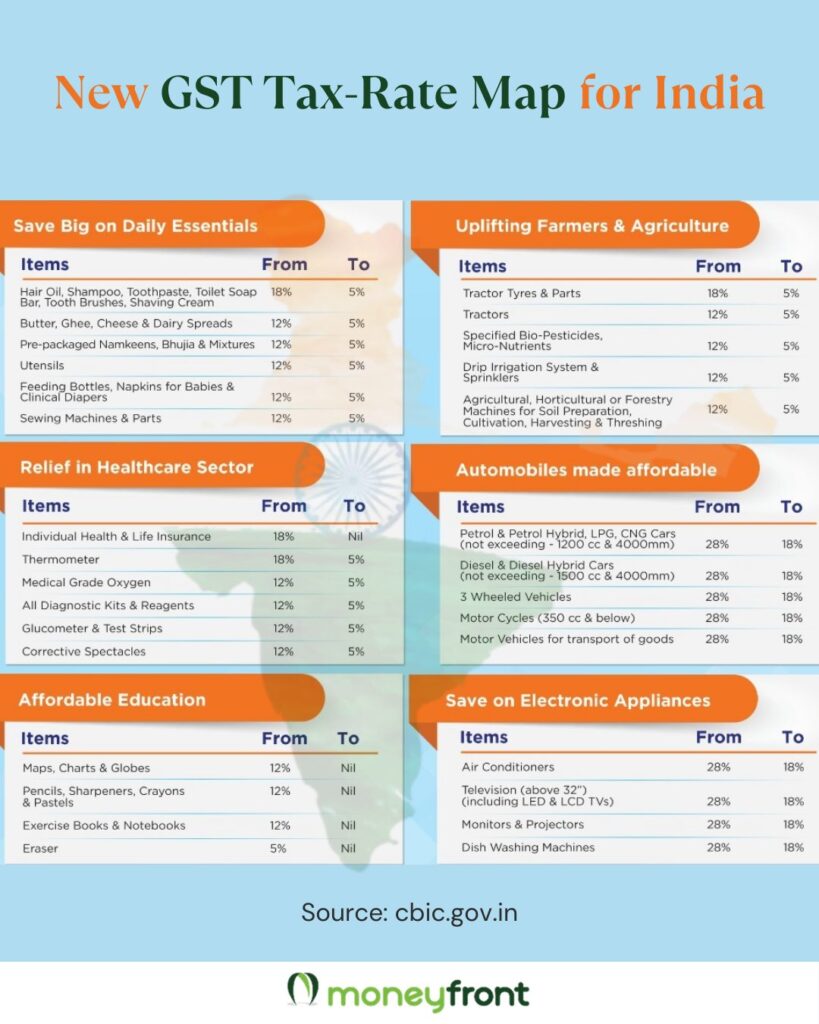
The most noticeable change is for common households. A lot of everyday products have been moved to the lower 5% bracket—or made completely tax-free.
Examples include:
- Soaps, toothpaste, and detergents
- Packaged food like biscuits, bread, and dairy products (paneer, ghee, butter, cheese)
- Basic medicines and some life-saving drugs
- Farming equipment and irrigation machinery
Another huge relief: life insurance and health insurance premiums are now free of GST. Earlier, they carried 18% tax, which made them costly for middle-class families. This move is expected to increase insurance coverage in India, which has always been lower compared to global standards.
For households, this means the monthly grocery bill and annual medical/insurance costs will now shrink. For farmers, cheaper equipment means lower input costs and better profitability.
Relief on Household Goods and Automobiles
If you’ve been holding back on buying a new fridge, AC, or TV, this reform might push you to go ahead. Household goods like:
- Refrigerators, washing machines, air-conditioners
- Cement and building materials
- Small cars, two-wheelers, and tractors
…all now fall under the 18% slab, compared to the 28% or higher earlier.
This is a big step because these items directly impact both urban and rural India. A farmer buying a tractor, a middle-class family upgrading to a two-wheeler, or a young couple buying a fridge for their new home—all will benefit.
Luxury and Harmful Items Get Costlier
On the flip side, luxury and harmful products have been taxed higher at 40%. This includes:
- Cigarettes and tobacco products
- Aerated drinks and alcohol
- High-end cars and SUVs
- Other luxury lifestyle goods
The message is clear: essential goods should be affordable, but indulgent or harmful items should carry a higher cost. This will not only bring extra revenue to the government but also encourage healthier choices.
Impact on Inflation and Economy
The government knows that lowering GST rates on essentials will reduce tax revenue in the short term. Reports suggest India may lose about ₹48,000 crore initially. But the logic is simple—if goods are cheaper, people will buy more, and this higher consumption will eventually make up for the lost revenue.
Experts also believe that inflation may reduce by 0.8% to 1.1% because of lower tax rates. That means not just groceries, but also services like dining out, transport, and household appliances could feel lighter on the pocket.
For businesses, a two-slab system (5% and 18%) makes compliance easier, reduces disputes with tax authorities, and cuts down on filing errors. This is especially helpful for small traders and shopkeepers who struggled under the old system.
Sector-Wise Benefits
- Agriculture: Tractors, irrigation equipment, and dairy products get lower GST, directly helping farmers.
- Healthcare: Lower GST on medicines and zero GST on insurance will reduce medical expenses for families.
- Automobiles: Two-wheelers, tractors, and small cars become more affordable, boosting demand in rural and urban markets.
- FMCG (Fast Moving Consumer Goods): Companies making soaps, toothpaste, biscuits, and packaged food expect a big jump in sales.
- White Goods: Makers of fridges, ACs, TVs, and washing machines are hopeful for a festive demand surge.
Real-Life Examples
- A family of four in Delhi: Their monthly grocery bill of ₹8,000 could reduce by at least ₹400–₹500 because of lower GST on food and soaps.
- A farmer in Punjab: Buying a new tractor now costs lakhs less due to lower GST, helping him save big on investments.
- A salaried employee: His annual health insurance premium of ₹20,000 earlier had ₹3,600 GST added. Now, he pays only ₹20,000—straight saving.
- A smoker in Mumbai: A cigarette pack that cost ₹350 earlier could now cost over ₹400 due to the 40% slab.
The Bigger Picture
GST 2.0 is not just about rates—it’s about rebuilding trust in the system. For years, GST was seen as complicated, unfair, and unfriendly to the common man. With these changes, the government is trying to prove that taxation can be both simple and people-first.
Yes, there will be challenges in the transition. Businesses will need to update software, accountants will need to adjust, and states may initially worry about revenue sharing. But in the long run, this simplified system is expected to benefit both consumers and industries.
Conclusion
India’s GST 2.0 is a bold step towards a simpler, fairer, and more balanced taxation system. By lowering taxes on essentials, cutting costs on household goods, and raising taxes on luxury items, it strikes a balance between affordability and responsibility.
For the average Indian, it means cheaper groceries, lower medical costs, and more affordable purchases in the coming months. For businesses, it means less paperwork and more focus on growth.
As the reforms roll out this September, the real test will be how smoothly businesses adapt and how much relief actually reaches consumers. But for now, it looks like a much-needed festive gift for the people of India.