
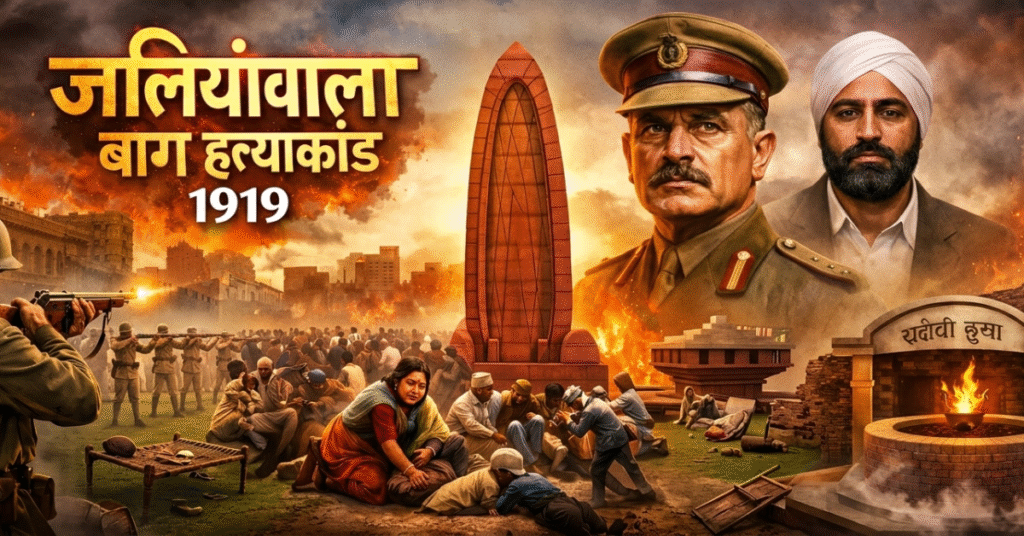
The Jallianwala Bagh massacre, known in Hindi as Jallianwala Bagh Hatyakand, is one of the most painful and defining moments in India’s struggle for independence. It is not just a historical event—it is a reminder of the sacrifices made by innocent people and the brutality of colonial rule.
On 13 April 1919, the peaceful city of Amritsar witnessed an incident that changed the course of India’s freedom movement. Thousands of unarmed men, women, and even children had gathered in Jallianwala Bagh, unaware that within minutes, their lives would be shattered forever.
Background: What Led to the Massacre?
To understand the Jallianwala Bagh tragedy, we must first examine the political climate in India at the time.
After World War I, Indians had expected some level of self-governance in return for supporting the British. Instead, the British government passed the Rowlatt Act, which allowed them to arrest anyone without trial and suppress any form of political protest.
This act caused widespread anger across the country. Leaders like Mahatma Gandhi called for peaceful protests and strikes. In Punjab, the situation became tense, especially after the arrest of two popular leaders, Dr. Saifuddin Kitchlew and Dr. Satyapal.
People were outraged, but most gatherings remained peaceful. Unfortunately, the British authorities decided to respond with extreme force.
The Day of Baisakhi: 13 April 1919
The massacre took place on the day of Baisakhi, one of the most important festivals in Punjab. Thousands of villagers had come to Amritsar to celebrate the festival. Many of them were not even aware of the political tensions.
By the afternoon, a large crowd had gathered at Jallianwala Bagh. Some were there to protest peacefully against the Rowlatt Act, while others had simply come for the festive occasion. The gathering was unarmed and non-violent.
However, the British administration had already banned public meetings. The crowd either didn’t know about this order or chose to ignore it, believing their intentions were harmless.
General Dyer’s Brutal Decision
The situation took a horrific turn when General Reginald Dyer entered Jallianwala Bagh with a group of armed soldiers.
Without issuing any proper warning to disperse, Dyer ordered his troops to open fire on the crowd. The soldiers positioned themselves at the only narrow entrance of the garden, blocking any escape.
For about 10 minutes, continuous gunfire rained down on innocent people.
- Over 1,600 rounds of ammunition were fired.
- People ran in panic, but there was nowhere to go.
- Many jumped into a well inside the garden to escape bullets.
The firing stopped only when the soldiers ran out of ammunition.
Casualties: A Debate That Still Continues
The exact number of people killed remains uncertain.
- Official British records claimed around 379 deaths.
- Indian sources and local accounts suggest over 1,000 people were killed.
- Thousands were injured, many of whom later died due to a lack of medical care.
The narrow exits, high walls, and sudden attack made it impossible for people to escape, turning the garden into a death trap.
Immediate Aftermath: Fear and Silence
After the massacre, the British authorities did not allow medical help to reach the wounded immediately. A curfew was imposed, leaving injured people to suffer through the night.
Punjab was placed under martial law, and strict measures were enforced:
- Public floggings
- Forced humiliations
- Arrests without trial
The aim was clear—to suppress any form of resistance through fear.
Also Read:- The Fall of the Golden Bird: How Britain Took Over India – lostnews
Reaction Across India
News of the massacre spread quickly across India, shocking the nation.
Even moderate leaders who had previously supported British rule were outraged. One of the strongest reactions came from Rabindranath Tagore, who returned his knighthood in protest, calling it a “badge of shame.”
Mahatma Gandhi, who had been advocating non-violent resistance, was deeply affected. This incident strengthened his resolve and led to the launch of the Non-Cooperation Movement in 1920.
The massacre marked a turning point—Indians no longer trusted British promises and began demanding complete independence.
The Hunter Commission Inquiry
Due to widespread outrage, the British government set up the Hunter Commission to investigate the incident.
General Dyer defended his actions, stating that he wanted to “teach a lesson” to the Indians. While the commission criticised him for excessive force, it did not impose severe punishment.
Dyer was eventually removed from his position but was supported by many in Britain, who saw him as a hero. This further angered Indians and widened the gap between the rulers and the ruled.
Long-Term Impact on India’s Freedom Struggle
The Jallianwala Bagh massacre had far-reaching consequences:
1. End of Faith in British Rule
Many Indians lost all trust in British governance. The illusion of fairness was shattered.
2. Rise of Nationalism
The incident united people across regions, religions, and communities against colonial rule.
3. Strengthening of Freedom Movements
Movements led by leaders like Mahatma Gandhi gained massive support.
4. Global Attention
The massacre drew international criticism, exposing the harsh realities of British colonialism.
Udham Singh: A Delayed but Powerful Response
The pain of Jallianwala Bagh did not fade with time. One man, Udham Singh, carried the memory of this tragedy for over two decades.
In 1940, he assassinated Michael O’Dwyer in London, holding him responsible for the massacre.
Udham Singh’s act was seen by many as a form of justice for the victims. He was later executed by the British, but his sacrifice remains an important part of India’s freedom struggle.
Jallianwala Bagh Today: A Place of Remembrance
Today, Jallianwala Bagh stands as a national memorial in Amritsar.
Visitors can still see:
- Bullet marks on the walls.
- The well into which people jumped.
- Memorial structures honouring the victims.
It is not just a tourist spot—it is a sacred place that reminds us of the cost of freedom.
Why This Incident Still Matters
More than a century has passed, but the Jallianwala Bagh massacre continues to hold deep emotional and historical significance.
It teaches us:
- The importance of standing against injustice.
- The value of unity in difficult times.
- The true cost of freedom.
It also reminds us to respect human rights and ensure that such tragedies are never repeated.
Conclusion
The Jallianwala Bagh Hatyakand is not just a chapter in history—it is a story of pain, courage, and awakening. The innocent lives lost on that day became a powerful force that pushed India closer to independence.
As we remember this tragedy, we must do so with respect, empathy, and gratitude for those who sacrificed everything for the nation.
Their voices may have been silenced that day, but their legacy continues to echo in the heart of every Indian.




1 thought on “13 April 1919 Jallianwala Bagh Hatyakand: The Day That Shook India Forever”