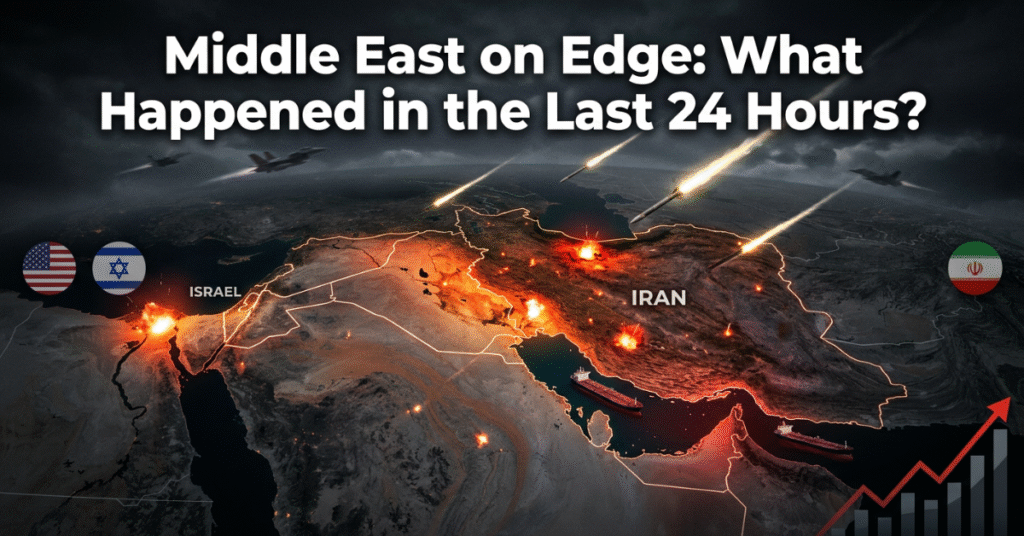
The past 24 hours have shaken the Middle East in a way few events have in recent years. What began as coordinated military action has quickly turned into a dangerous cycle of retaliation, diplomatic tension, and global anxiety.
At the centre of the storm are three key players: the United States, Israel, and Iran. Airstrikes, missile launches, emergency meetings, and global market reactions have unfolded rapidly — leaving the region on edge and the world watching closely.
Here’s a clear, human-friendly breakdown of what happened in the last 24 hours and why it matters.
Hour 1–4: Coordinated Airstrikes Inside Iran
The crisis escalated dramatically when the United States and Israel carried out coordinated airstrikes deep inside Iranian territory. According to early reports, the targets included:
- Military command centres
- Missile storage sites
- Strategic Revolutionary Guard facilities
- Infrastructure linked to Iran’s nuclear program
The most shocking development was the reported killing of Iran’s Supreme Leader, Ayatollah Ali Khamenei, along with other senior officials.
If confirmed, this marks one of the most serious confrontations between these nations in modern history. Unlike previous covert operations or proxy conflicts, these were open and highly visible strikes.
Within hours, Iranian state media condemned the attacks and promised retaliation.
Hour 5–10: Iran Launches Retaliation
Iran responded swiftly.
Missiles and armed drones were launched toward Israeli cities and U.S. military bases located in Gulf countries. Air raid sirens reportedly sounded across multiple urban areas in Israel. Defence systems were activated to intercept incoming threats.
Meanwhile, U.S. bases in the Gulf region were placed on high alert. Military personnel were moved to secure positions, and defensive systems were reinforced.
Iran’s retaliation signals that this conflict is not symbolic. It is active, direct, and potentially escalating.
Hour 11–16: Emergency Security Meetings Worldwide
As news spread, world leaders convened emergency security meetings.
Governments across Europe, Asia, and the Middle East called for restraint. Diplomatic channels were reportedly activated to prevent further strikes.
Some nations expressed support for the operation, arguing that action against Iran’s nuclear-linked infrastructure was necessary for regional security. Others warned that the situation could spiral into a full-scale regional war.
Global institutions and international diplomats began urging de-escalation, emphasising that continued retaliation could destabilise the entire region.
Hour 17–20: Oil Prices Surge
The economic impact was immediate.
One of the biggest concerns centres around the Strait of Hormuz, a narrow waterway through which a significant portion of the world’s oil supply passes daily.
Any threat to this route could disrupt global energy markets.
Within hours of the escalation:
- Oil prices jumped sharply.
- Stock markets showed volatility.
- Gold prices rose as investors sought safer assets.
For ordinary people, this could eventually mean higher fuel prices and increased inflation if tensions continue.
Also Read: – Major Escalation in the Middle East: US & Israel vs. Iran — A Turning Point in Global Politics – lostnews
Hour 21–24: Regional Military Mobilisation
By the end of the 24 hours, military activity had intensified across the region.
- Israeli defence forces remained on high alert.
- U.S. naval and air units repositioned in the Gulf.
- Iran signalled that its response was “not over.”
There is growing concern that allied groups across the region — particularly in Lebanon, Syria, and Iraq — could become involved, widening the conflict.
This is the key fear: escalation beyond direct exchanges into a broader regional war.
Why This Moment Is Different
The Middle East has seen conflict before. But several factors make this moment particularly dangerous:
- Direct State-to-State Strikes: These are not proxy attacks. They are open military operations between governments.
- High-Level Leadership Impact: Reports of the death of Iran’s top leader add a deeply symbolic and political dimension.
- Nuclear Tensions: Iran’s nuclear program has long been a flashpoint. Targeting related infrastructure raises long-term security questions.
- Economic Risk: Energy markets are closely linked to Middle Eastern stability.
The speed of escalation within just 24 hours shows how fragile the regional balance has become.
What Could Happen Next?
Several scenarios are possible:
1. Controlled Retaliation and Pause
Both sides exchange limited strikes but avoid further escalation, opening space for diplomatic negotiations.
2. Regional Expansion
Allied groups or neighbouring countries become involved, widening the conflict zone.
3. Economic Warfare
Sanctions, cyberattacks, and disruptions to shipping lanes increase without full-scale war.
4. Full Regional War
A worst-case scenario involving sustained missile exchanges, naval confrontations, and widespread instability.
Right now, it is too early to say which path the region will take.
Impact on Ordinary People
While leaders make decisions, ordinary citizens often feel the consequences first.
In Israel and parts of the Gulf, civilians have taken shelter as sirens sound. In Iran, uncertainty surrounds political leadership and security conditions.
Globally, people are watching oil prices, market movements, and diplomatic headlines.
For countries like India, which rely heavily on Middle Eastern oil imports, prolonged instability could affect fuel costs and trade balances.
The Diplomatic Window
Despite rising tensions, diplomatic channels remain open. History shows that even intense military escalations can sometimes lead to negotiations.
The coming days will be critical. If further large-scale strikes occur, the chance of de-escalation narrows. If restraint is shown, talks may resume.
Also Read: – “Hijabs, Hostages & History: Breaking Down Iran’s Islamic Revolution” – lostnews
Final Thoughts
In just 24 hours, the Middle East has moved from tense stability to open confrontation.
Airstrikes, missile retaliation, emergency global meetings, and economic tremors have unfolded rapidly. The involvement of the United States, Israel, and Iran places this crisis at the centre of global politics.
The world now waits to see whether the next 24 hours bring further escalation — or the first signs of restraint.
One thing is clear: the region stands at a critical crossroads, and the decisions made now will shape the future of Middle Eastern stability for years to come.