
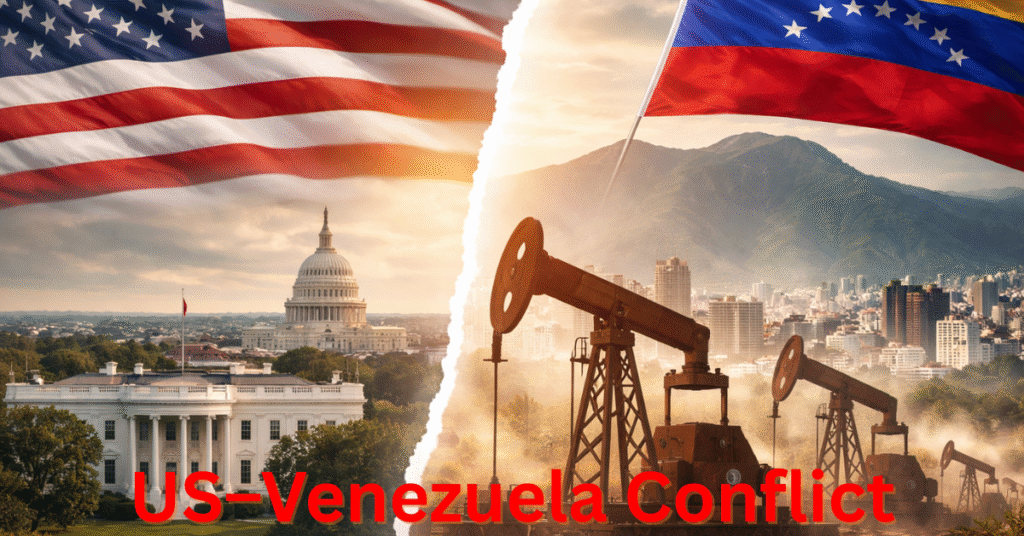
The US–Venezuela conflict is one of the most complex and long-running political confrontations in recent Latin American history. It did not appear overnight, but grew over decades due to differences in political ideology, economic interests, and global strategic alignments. To truly understand this conflict, we must look back at how relations between Washington and Caracas evolved from cooperation to deep hostility.
From Friendly Partnership to Political Divide (Pre-1999)
For much of the 20th century, Venezuela and the United States maintained relatively stable and cooperative relations. Venezuela was a crucial oil supplier to the world, particularly to the United States, and this economic partnership anchored friendly ties. Caracas and Washington worked together on trade, investment, and regional security, and Venezuela was considered one of the United States’ closest allies in Latin America.
However, this relationship began to change as political ideas shifted in Venezuelan society. By the late 1990s, years of economic inequality, corruption, and dissatisfaction with traditional politics created fertile ground for a dramatic transformation. This shift would mark the start of the modern US–Venezuela conflict.
Hugo Chávez and the Bolivarian Revolution (1999 Onwards)
The turning point in relations came in 1999, when Hugo Chávez was elected president of Venezuela. Running on a platform that rejected what he called “neoliberalism” and U.S. influence in Latin America, Chávez launched the Bolivarian Revolution. His policies aimed to redistribute wealth, nationalise key industries, and assert Venezuela’s independence from Western influence.
Chávez’s approach included rewriting the constitution, expanding social welfare programmes, and taking greater control over Venezuela’s oil industry. While these policies were popular among many Venezuelans, they unsettled Washington, which saw a growing anti-US rhetoric and closer Venezuelan ties with U.S. rivals such as Cuba, Russia, Iran, and China.
Chávez’s alliances with these nations signalled to the United States that Venezuela was shifting away from a Western sphere of influence toward a more independent and sometimes adversarial global stance. This was the first major fault line in what would eventually become the US–Venezuela conflict.
Accusations, Diplomacy Breakdown, and Early Tensions
Also Read: – Explained: U.S. 50% Tariffs on Indian Exports and What It Means for You – lostnews
The early 2000s were marked by escalating suspicion. In 2002, a coup briefly removed Chávez from power for 48 hours. Although Chávez was quickly restored, many in Venezuela blamed the United States for supporting the coup—a claim Washington repeatedly denied. However, the episode severely eroded mutual trust.
Diplomatic frictions continued as Venezuela expelled U.S. diplomats and accused the United States of meddling in its internal affairs. At the same time, the U.S. criticised Caracas for human rights violations and lack of democratic transparency. Relations reached a new low in 2019 when the United States openly recognised opposition leader Juan Guaidó as Venezuela’s interim president after Nicolás Maduro’s contested re-election, prompting Maduro to sever formal diplomatic ties.
Sanctions as a Political Tool
One of the defining features of the US–Venezuela conflict has been the use of sanctions. In 2014, the U.S. Congress passed the Venezuela Defense of Human Rights and Civil Society Act, which authorised the U.S. government to impose sanctions on Venezuelan officials accused of violating human rights or undermining democracy.
Over the years, these sanctions expanded, targeting not only individual officials but also Venezuelan state entities and the oil sector—the backbone of Venezuela’s economy. Washington’s aim was to pressure Maduro’s government to restore democratic norms and end corruption. Caracas, however, viewed these measures as economic warfare designed to destabilise its government.
Narco-terrorism Charges and Deepening Conflict
In March 2020, U.S. prosecutors indicted Nicolás Maduro and 14 other Venezuelan officials on charges related to narco-terrorism, accusing them of running criminal networks and using state resources to facilitate drug trafficking. The U.S. Department of Justice alleged these operations threatened American society and security. Caracas vehemently denied these accusations, calling them politically motivated and part of a strategy to justify tougher actions against Venezuela.
These indictments marked a shift in the US–Venezuela conflict, as what was once mostly diplomatic pressure became part of a broader legal and criminal narrative. The Trump administration designated Venezuelan criminal organisations as terrorist entities, further legitimising U.S. punitive actions in the eyes of Washington.
Oil, Economy, and Geopolitical Competition
Venezuela holds some of the largest proven oil reserves in the world, and oil has been central to both its economy and its foreign relations. The United States, once the biggest buyer of Venezuelan crude, gradually reduced its dependence on Venezuelan oil due to sanctions and shifting energy markets. Venezuela, in turn, deepened its energy ties with China, Russia, and other nations that were willing to buy its oil despite U.S. sanctions.
This competition for influence over Venezuela’s oil resources became another root of the US–Venezuela conflict. Control over energy markets and geopolitical alliances turned Caracas into a point of contention between Washington and other global powers.
Recent Escalations and the Conflict Today
In the most recent phase of the US–Venezuela conflict, tensions have spilled beyond sanctions and rhetoric into concrete actions. In late 2025 and early 2026, the United States has taken unprecedented measures—including intercepting and seizing oil tankers linked to Venezuela, enforcing a naval blockade on sanctioned vessels, and expanding military operations near Venezuelan waters. Caracas has condemned these moves as violations of sovereignty and international law.
These developments reflect how far the conflict has moved from diplomatic disagreements to direct economic and military pressure. They also show how the US–Venezuela conflict now involves broader global dynamics, including reactions from Russia, China, and regional partners.
Also Read: – Trump Meets PutiN – Find out what Conspired at ALASKA? – lostnews
Conclusion
The roots of the US–Venezuela conflict stretch back decades and are intertwined with politics, ideology, economic interests, and global power struggles. From the rise of Hugo Chávez to recent military and economic confrontations, this conflict has continually evolved, shaping not only the futures of both nations but also influencing wider global geopolitics. Understanding these historical foundations is critical to grasping where the conflict stands today and how it might unfold in the years ahead.



1 thought on “The Roots of the US–Venezuela Conflict: How It All Started”