
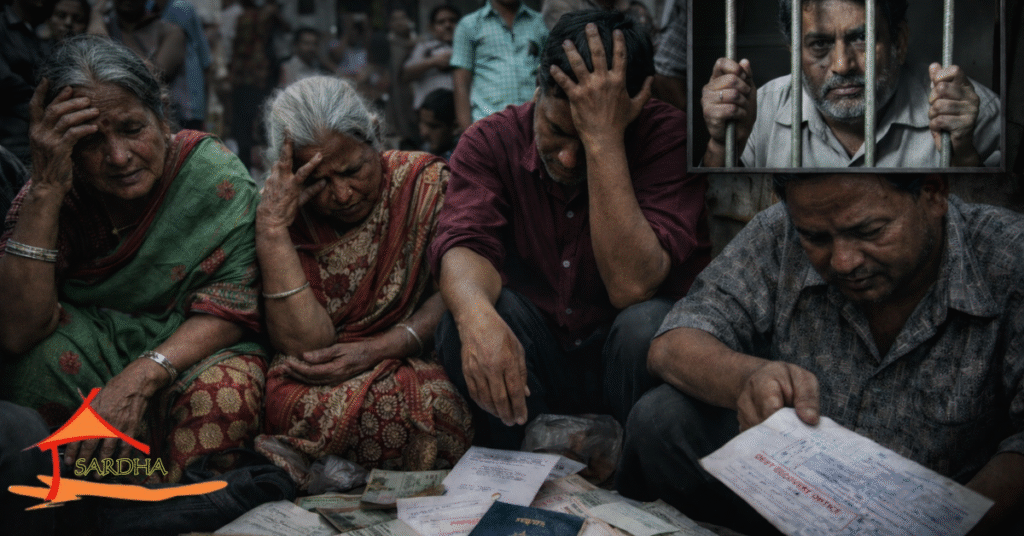
The Saradha Chit Fund Scam (2013) is remembered not just as a financial fraud but as a human tragedy that shook eastern India. Unlike stock market scams that affected investors with disposable income, this scandal preyed on small savers — daily wage workers, farmers, retired employees, and homemakers — people who trusted the system with their life savings.
When the Saradha Group collapsed in 2013, it left behind broken families, protests on the streets, and serious questions about political protection, regulatory failure, and moral responsibility.
What Was the Saradha Chit Fund Scam (2013)?
The Saradha scam was a massive Ponzi scheme run under the guise of chit funds, collective investment schemes, real estate projects, and tourism businesses.
Instead of generating genuine profits, the company used new investors’ money to pay earlier investors, creating an illusion of steady returns. When fresh money stopped coming in, the entire structure collapsed.
At its peak, the scam was estimated to be worth ₹20,000–25,000 crore, affecting over 1.7 million investors, mainly in West Bengal, Assam, Odisha, and Tripura.
Who Founded the Saradha Group?
The Saradha Group was founded by Sudipta Sen, a former journalist who understood public trust, media influence, and political connections.
From a small business, the group expanded rapidly into:
- Chit funds
- Real estate
- Media companies
- Travel and tourism
- Construction projects
Many of these businesses existed largely on paper.
How the Scam Operated
False Promises, Real Money
The Saradha Group promised returns of 10–40%, far higher than those offered by banks or post office schemes. Agents convinced investors that their money was safe because:
- The company had offices everywhere.
- Politicians attended company events.
- Local leaders endorsed the scheme.
- Payments initially came on time.
Thousands of agents were recruited, earning commissions by bringing in more people.
Also Read: – Harshad Mehta Stock Market Scam (1992): The Rise, the Fraud, and the Fall That Shook India’s Financial System
Use of Media to Build Trust
One unique feature of the Saradha Chit Fund Scam (2013) was the use of media houses to gain legitimacy.
The Saradha Group owned or controlled several Bengali media outlets, including:
- Newspapers
- TV channels
- Magazines
Journalists were paid well, and negative coverage was avoided. This made ordinary people believe the company was credible and politically protected.
Political Connections and Allegations
The scam turned explosive when political names surfaced.
Alleged Political Figures Linked (as per investigations)
Important: Being named does not imply guilt unless proven in court.
- Madan Mitra – Former West Bengal minister (arrested)
- Kunal Ghosh – Former MP and Saradha media CEO (arrested)
- Tapas Pal – Former MP (arrested)
- Srinjoy Bose – Journalist and MP (arrested)
Several others were questioned by investigating agencies.
Sudipta Sen himself alleged that large sums were paid to political leaders for protection — claims that became part of the investigation records.
Collapse of the Saradha Group
In April 2013, everything fell apart.
Sudipta Sen suddenly disappeared, leaving behind a confession letter running into several pages. In the letter, he:
- Admitted that the business model was unsustainable
- Blamed political pressure
- Claimed extortion and threats
- Expressed fear for his life
Soon after, the Saradha offices shut down, payments stopped, and panic spread across states.
Arrest of Sudipta Sen
Sudipta Sen was arrested in Sonmarg, Jammu & Kashmir, while allegedly attempting to flee the country.
Along with him, Debjani Mukherjee, a close associate, was also arrested. They were brought to Kolkata under heavy security.
Human Cost of the Scam
The most heartbreaking aspect of the Saradha Chit Fund Scam (2013) was its impact on ordinary people.
- Many investors lost their entire life savings.
- Several cases of suicide were reported.
- Families were pushed into debt.
- Trust in financial systems collapsed.
Agents, who were often victims themselves, were attacked by angry investors.
Role of Regulatory Failure
One of the biggest questions raised was: How did this go on for years?
Reasons Identified:
- Weak regulation of chit funds
- Poor coordination between state and central agencies
- Lack of investor awareness
- Political interference allegations
- Absence of strict enforcement by SEBI initially
The scam exposed massive loopholes in the monitoring of collective investment schemes.
CBI and ED Investigations
Due to the scale and political sensitivity, the Supreme Court transferred the case to the CBI in 2014.
Agencies Involved:
- CBI – Criminal conspiracy and fraud
- Enforcement Directorate (ED) – Money laundering
- SEBI – Regulatory violations
The ED attached properties worth hundreds of crores linked to the Saradha Group and its associates.
Court Cases and Status
- Multiple charge sheets were filed.
- Several politicians and officials were arrested.
- Sudipta Sen remains in judicial custody.
- Cases are still ongoing in various courts.
Recovery of money has been slow, and only partial compensation has reached victims.
Compensation and Relief Measures
The West Bengal government set up a relief fund to compensate victims. However:
- Payments were limited
- Not all investors were covered.
- Many claims are still pending.
For many families, the financial damage remains permanent.
Why the Saradha Chit Fund Scam (2013) Still Matters
This scam changed India’s financial landscape in important ways:
- Stricter regulation of chit funds
- Better coordination between SEBI and state authorities
- Increased awareness about Ponzi schemes
- Greater scrutiny of political–business links
It also showed how financial illiteracy and blind trust can be exploited on a massive scale.
Also Read: – Top 11 Biggest Scams That Shocked India: A Look at How Billions Were Lost
Lessons from the Scam
The Saradha scam taught India painful lessons:
- High returns always carry high risk.
- Political endorsement is not financial security.
- Media presence does not equal legitimacy.
- Regulation must be proactive, not reactive.
Most importantly, it reminded the country that small investors need the strongest protection.
Final Thoughts
The Saradha Chit Fund Scam (2013) was not just about illegal money — it was about shattered hopes. It exposed how easily trust can be monetised and how devastating the consequences can be when oversight fails.
Even years later, the scars remain. For millions, Saradha is not a case study — it is a personal loss that changed their lives forever.






1 thought on “Saradha Chit Fund Scam (2013): How a Ponzi Scheme Destroyed Lives and Exposed Systemic Failure”