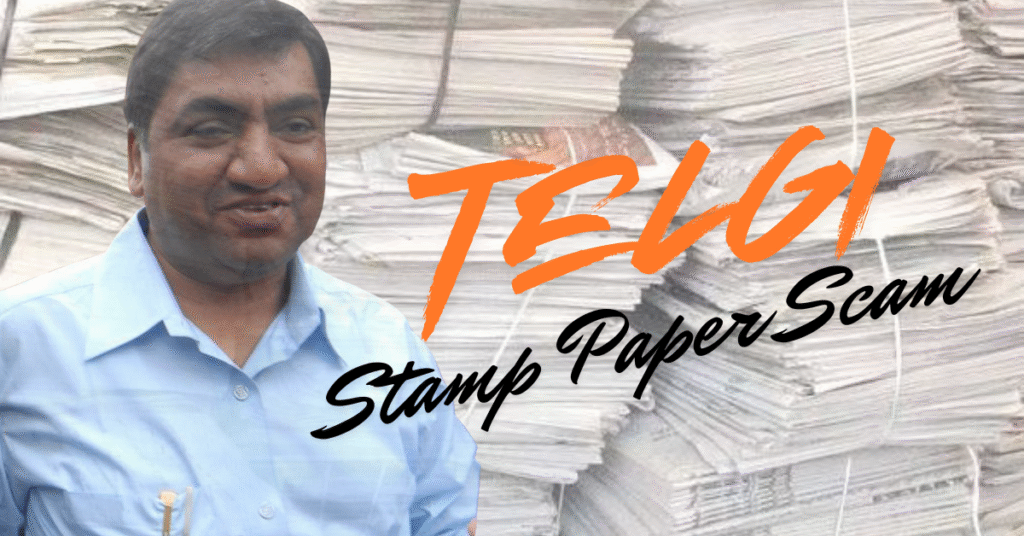
The Telgi Stamp Paper Scam (2003) is remembered as one of the most shocking financial scandals in India’s history. What made it especially disturbing was not just the scale of money involved, but the way the scam quietly infiltrated courts, banks, government offices, and law-enforcement agencies across multiple states.
For years, fake stamp papers circulated freely in the system — used for property deals, court affidavits, loan documents, and legal agreements — without anyone suspecting that the very foundation of official paperwork had been compromised.
When the truth finally came out, it exposed a massive network of corruption involving politicians, police officers, bureaucrats, and middlemen, all working together behind the scenes.
What Was the Telgi Stamp Paper Scam (2003)?
The Telgi Stamp Paper Scam (2003) was a large-scale fraud involving the printing and sale of fake stamp papers across India. These counterfeit stamp papers were made to look exactly like genuine government-issued ones and were sold to lawyers, banks, companies, and individuals.
Stamp papers are used to pay government stamp duty and are legally required for many transactions. By flooding the market with fake papers, the scam caused huge losses to state governments while undermining the credibility of legal documents nationwide.
The estimated value of the scam ranged from ₹20,000 crore to over ₹30,000 crore, making it one of the costliest frauds ever uncovered.
Also Read: – ABG Shipyard Bank Fraud (2022): Inside India’s Biggest Ever Loan Scam – lostnews
Who Was Abdul Karim Telgi?
At the centre of the scandal was Abdul Karim Telgi, the mastermind behind the operation.
Telgi was born into a poor family in Karnataka and started his career selling fruits. Over time, he moved into document trading and gradually learned how the stamp paper system worked. What began as small-scale forgery eventually turned into a nationwide criminal empire.
Telgi used his sharp understanding of bureaucracy and loopholes in the system to build a network that stretched across Maharashtra, Karnataka, Tamil Nadu, Gujarat, Delhi, Andhra Pradesh, and other states.
How the Scam Was Carried Out
The fraud was far more sophisticated than simple forgery.
Telgi and his associates:
- Set up illegal printing presses using high-quality paper.
- Used genuine stamp paper printing machines obtained through bribery
- Forged government seals, serial numbers, and security features
- Distributed fake stamp papers through licensed vendors
- Paid huge bribes to police officers and government officials to stay protected
In some cases, Telgi allegedly obtained official government printing permissions, allowing fake papers to be printed almost openly.
Who Were Involved in the Scam?
The Telgi Stamp Paper Scam (2003) was not the work of a single man.
Main Accused
- Abdul Karim Telgi – Mastermind
- Shamim Telgi – Brother and close associate
Others Involved
- Senior police officers in Maharashtra and Karnataka
- Government printing press officials
- Stamp vendors and distributors
- Middlemen and financiers
- Politicians allegedly received protection money.
Several IPS officers were accused of shielding Telgi in return for bribes, including high-ranking officials who later faced departmental action.
How the Scam Was Exposed
The scam began to unravel in the early 2000s, when irregularities in stamp paper serial numbers were noticed during routine checks.
The real breakthrough came when journalists and investigators raised questions about how fake stamp papers were reaching official offices so easily.
In 2003, Telgi was arrested, and massive raids were conducted across India. Printing presses, forged documents, cash, and fake stamps worth crores were seized.
The scale of the operation shocked investigators.
Role of Police and Government Officials
One of the most disturbing aspects of the Telgi Stamp Paper Scam was the involvement of law enforcement itself.
Investigations revealed that:
- Police officers ignored complaints against Telgi.
- Arrests were deliberately
- Evidence was destroyed or tampered with
- Officers received monthly payments to provide protection.
The Justice B.N. Agarwal Commission was later set up to probe police involvement in Maharashtra.
Legal Proceedings and Convictions
Abdul Karim Telgi faced multiple cases under:
- Indian Penal Code (IPC)
- Prevention of Corruption Act
- Forgery and criminal conspiracy laws
In 2006, Telgi was convicted in several cases and sentenced to rigorous imprisonment, with cumulative sentences running into 30 years or more.
Many police officers were dismissed, suspended, or prosecuted following the commission’s findings.
Telgi died in prison in 2017 after a prolonged illness.
Impact of the Telgi Stamp Paper Scam (2003)
The scam had long-lasting consequences:
- State governments lost billions in stamp duty revenue.
- Courts questioned the validity of thousands of legal documents.
- Banking and property transactions faced scrutiny.
- Public trust in government systems was severely damaged.
The scam forced authorities to rethink how stamp duty was collected and monitored.
Reforms After the Scam
Following the scandal:
- E-stamp paper systems were introduced.
- Manual stamp papers were phased out in many states.
- Digital verification of stamp duty was strengthened.
- Oversight of printing presses improved.
These reforms were meant to ensure that such a scam could never happen again.
Why the Scam Went Undetected for So Long
The Telgi Stamp Paper Scam (2003) survived for years because:
- The system relied heavily on physical paperwork.
- Oversight was weak
- Corruption protected the fraud.
- No centralised verification system existed.
It was a classic case of how a broken system can be exploited from within.
Also Read: – Top 11 Biggest Scams That Shocked India: A Look at How Billions Were Lost
Final Thoughts
The Telgi Stamp Paper Scam (2003) was not just a financial fraud — it was an attack on the credibility of India’s legal and administrative framework. It showed how corruption, when left unchecked, can quietly grow into a national crisis.
Even today, the scam stands as a reminder that transparency, accountability, and strong institutions are essential to protect public trust.
History may move on, but the lessons from the Telgi scam remain painfully relevant.