
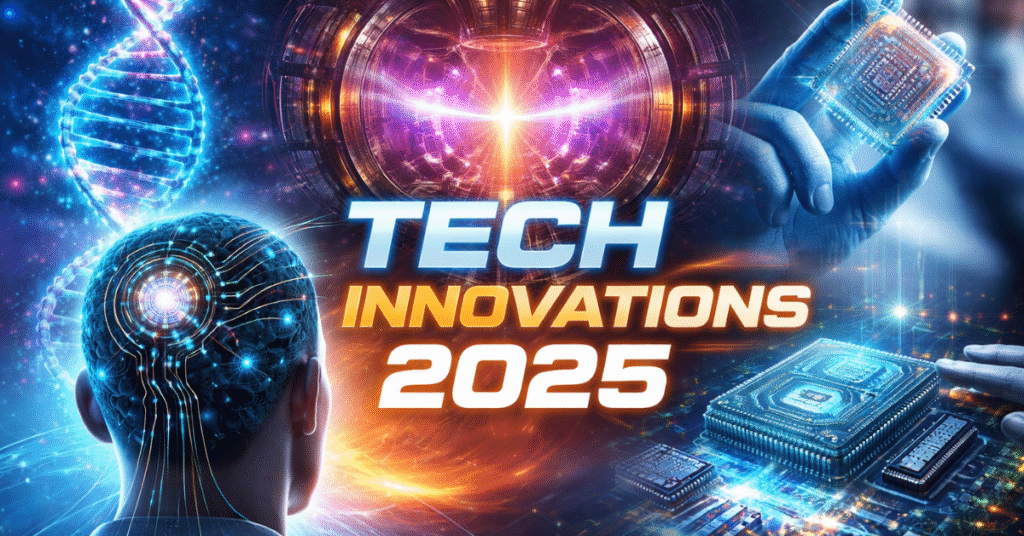
For many years, several breakthrough ideas felt like pure science fiction—limited to academic journals or futuristic films. However, tech innovation in 2025 has brought those ideas out of the laboratory and into real life. What once seemed distant is now shaping everyday experiences, transforming how we live, improve our health, process information, and generate energy for the world.
From smarter artificial intelligence and advanced gene editing to clean fusion energy and mind-controlled machines, 2025 marked a turning point. The world didn’t just witness upgrades—it saw entire industries move into a new phase of maturity.
Here are the five most groundbreaking technological innovations of 2025, explained simply and clearly.
1. Artificial Intelligence Became Smarter—and More Human-Centric
Artificial intelligence remained at the centre of tech innovation in 2025, but the focus changed. Instead of flashy chatbots, the real progress came from context-aware and long-term AI systems.
These new AI models could remember user preferences, behaviour patterns, and goals over weeks or even months. This allowed them to act more like digital partners rather than one-time tools. AI agents began managing calendars, tracking expenses, ordering daily essentials, and analysing health data from wearables to detect early warning signs of illness.
Another major shift was affordability. Open-source AI projects gained serious momentum. Models like DeepSeek proved that powerful AI no longer needs massive budgets. By optimising computing efficiency, these systems delivered near top-tier performance at a fraction of the cost, reducing dependence on large tech corporations.
This democratisation of AI is one of the most important tech innovation stories of the year, as it allows startups, students, and small businesses to compete on a global level.
Also Read: – Top 7 Future Tech Trends That Will Shape the Next Decade – lostnews
2. Gene Editing Reached a Safer and Smarter Phase
Medical tech innovation in 2025 took a big leap forward with CRISPR 3.0. Unlike earlier versions of gene-editing tools that relied on cutting DNA strands, the latest approach works with chemical precision.
CRISPR 3.0 allows scientists to make targeted changes to specific genetic locations without breaking DNA. This greatly reduces the risk of unwanted mutations and makes the technology safer for human trials.
Large-scale clinical trials expanded for genetic disorders such as sickle-cell disease, inherited blindness, and rare immune conditions. One of the most promising developments was in cancer treatment, where a patient’s own immune cells were reprogrammed to hunt and destroy difficult tumours.
Instead of treating symptoms, medicine is slowly moving toward fixing diseases at their source—a powerful example of how tech innovation is redefining healthcare.
3. Fusion Energy Proved It Is No Longer a Dream
Energy tech innovation reached a milestone in 2025 with major breakthroughs in nuclear fusion. For the first time, research labs across the world managed to sustain fusion reactions that produced more energy than they consumed—and for longer durations.
Fusion energy works by replicating the reaction that powers the Sun. Unlike fossil fuels or traditional nuclear power, fusion produces enormous energy with minimal waste and no carbon emissions.
India also made steady progress through projects like SST-Bharat, being developed by the Institute for Plasma Research in Gandhinagar. If successful, it could play a key role in India’s long-term clean energy strategy.
While commercial fusion power plants are still some years away, 2025 showed that fusion is technically achievable—marking one of the biggest clean-energy tech innovations of our time.
4. Brain-Computer Interfaces Entered Medical Reality
One of the most talked-about tech innovation stories of 2025 was the real-world use of brain-computer interfaces (BCIs). After years of limited testing, fully implanted wireless BCIs received regulatory approval in parts of the US and Europe.
These devices allowed patients with paralysis to type messages, control robotic limbs, and operate digital devices using only their thoughts. The technology became more stable and accurate compared to earlier prototypes.
Neuralink, founded by Elon Musk, received special regulatory recognition for its implant designed to help people with speech impairments communicate more effectively.
Although ethical discussions continue, BCIs have already begun changing lives, making this one of the most human-impact-driven tech innovations of the year.
Also Read: – Unstoppable Momentum: How Germany Automotive Innovation Is Leading the tech and EV Race
5. Quantum Computing Took Practical Steps Forward
Quantum computing crossed an important threshold in 2025. Systems with over 1,000 working qubits demonstrated improved error correction, making their results more reliable than ever before.
New modular designs allowed quantum computers to scale without becoming unstable—a challenge that had limited progress for years. This made quantum systems more practical for solving real-world problems.
Early applications showed promise in drug discovery, materials science, logistics optimisation, and traffic management. At the same time, startups launched quantum cloud platforms, allowing businesses to access quantum computing power remotely—similar to existing cloud services.
This shift signals that quantum computing is slowly moving from experimental research into usable tech innovation.
Final Thoughts: Why 2025 Matters
What sets tech innovation in 2025 apart is maturity. Instead of bold promises, the world saw functioning systems, regulatory approvals, and real users benefiting from advanced technology.
The coming years will determine how responsibly these tools are used, but one thing is clear—technology has entered a new phase where progress is no longer theoretical. The future is no longer approaching. It has already arrived.






3 thoughts on “The Most Exciting Tech Innovations of 2025 That Are Changing the World Faster Than Expected”