
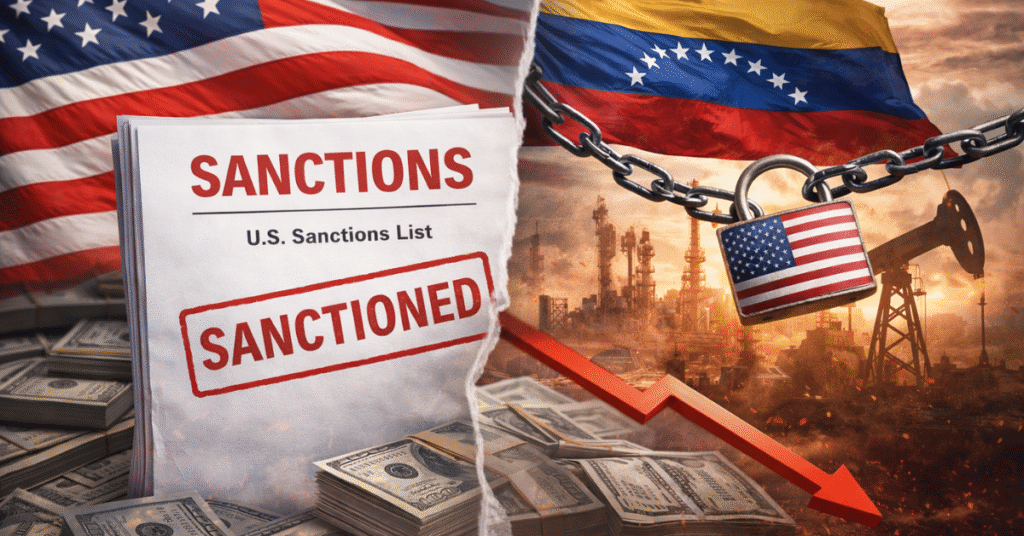
The US–Venezuela conflict has been shaped not only by diplomatic tensions and political disagreements but also by the United States’ escalating economic sanctions against Venezuela. These sanctions, which have become a central tool of U.S. policy toward Caracas, are rooted in a mix of political, security, economic, and human rights concerns. To fully understand why the United States imposed sanctions on Venezuela, we need to examine the reasons behind the sanctions, the timeline of key measures, and the impact these actions have had on Venezuela’s economy, global relations, and the lives of ordinary citizens.
Why Sanctions Became a Key Tool
Economic sanctions are a form of coercive diplomacy — pressure without military conflict — used by countries to influence the behaviour of other governments. In the case of Venezuela, U.S. sanctions were intended to push the Venezuelan government toward democratic reforms, punish alleged corruption and human rights abuses, and constrict financial and logistical support to activities the United States considers harmful to its national interests.
At the core of these measures are several major U.S. concerns:
1. Democracy and Human Rights Issues
The United States began applying targeted sanctions in response to what it saw as anti-democratic behavior and human rights violations by the Venezuelan government. In 2014, Congress passed the Venezuela Defense of Human Rights and Civil Society Act, enabling sanctions against Venezuelan officials who were judged responsible for the repression of protesters and undermining democratic processes.
This initial legislative action was a signal that Washington viewed political developments in Venezuela — especially crackdowns on opposition and irregular elections — as a justification for economic pressure.
2. Narcotics and Security Concerns
Even before the crisis reached its peak, the United States had concerns about Venezuela’s role in regional drug trafficking and cooperation with armed groups. As early as 2008, sanctions targeted Venezuelan officials suspected of assisting Colombian rebel groups in drug smuggling operations.
In later years, particularly under the Trump administration, these concerns intensified. The U.S. Justice Department indicted Venezuelan President Nicolás Maduro and senior officials on “narco-terrorism” charges, asserting that the regime ran elaborate drug trafficking networks. This narrative helped frame Venezuela not only as a political threat but as a national security risk.
Also Read: – The Roots of the US–Venezuela Conflict: How It All Started – lostnews
3. Oil, Revenue, and Economic Leverage
Venezuela’s economy has historically been overwhelmingly dependent on oil exports. Washington recognised that targeting Venezuela’s oil revenue — its economic lifeblood — could substantially weaken the Maduro government’s ability to fund its operations.
Although sanctions on the petroleum sector were not immediate, they eventually became one of the most consequential components of the sanctions. Under Executive Orders issued during the Trump era (notably EO 13850 and later EO 13884), the United States blocked assets of the Venezuelan government and restricted transactions with state oil company PDVSA and the Venezuelan central bank.
Limiting Venezuela’s access to dollar-based financial systems and oil markets was not only punitive — it was designed to strangle Caracas’s main revenue source and isolate its financial infrastructure.
4. Global Strategic Rivalries
Another driving factor in the US–Venezuela conflict is geopolitics. Venezuela’s increasing alliances with countries seen by Washington as adversaries — such as China, Russia, and Iran — alarmed U.S. policymakers. These relationships were seen as a challenge to U.S. influence in Latin America and a strategic risk given Venezuela’s resource wealth and geographic position.
Sanctions, therefore, also functioned as part of a broader effort to counter extra-regional powers gaining influence in the Western Hemisphere.
Timeline: Key Sanctions and Escalations
Understanding the evolution of U.S. sanctions helps explain why relations between Washington and Caracas became so strained:
2006–2014: Early Measures
U.S. sanctions against Venezuelan individuals and associates began as early as 2005 and 2006, initially tied to narcotics trafficking concerns. Sanctions were modest and targeted specific officials and entities.
By 2014, in response to domestic unrest and human rights complaints in Venezuela, the United States passed laws enabling broader punitive actions against officials linked to political repression.
2017–2019: Expansion Under Trump
President Donald Trump significantly expanded sanctions against Venezuela. In 2017 and 2018, executive orders authorised the blocking of property and the prohibition of transactions with the Venezuelan government. Major actions included sanctions targeting PDVSA — Venezuela’s state oil company — and financial sanctions that restricted Caracas’s ability to engage with U.S. and global financial systems.
Oil export revenues plummeted as a result, with Venezuelan petroleum income falling sharply due to reduced market access and financial penalties.
2019 Onwards: Full Economic Embargo and Asset Freezes
In 2019, the United States imposed a near-complete embargo on Venezuelan oil exports and froze significant Venezuelan government assets. Caracas was also cut off from accessing funds, and many foreign financial institutions avoided transactions tied to Venezuela due to fears of U.S. secondary sanctions.
Subsequent years saw sanctions extend to vessels and tanker companies linked to Venezuelan oil shipping, further tightening economic pressure.
Impact of Sanctions
The sanctions imposed by the United States have had far-reaching consequences for Venezuela’s economy and society:
Economic Contraction and Oil Revenue Losses
Sanctions against PDVSA and the central bank cut into Venezuela’s oil revenue, which historically constituted over 90% of export earnings. Restrictions on financial transactions and asset freezes exacerbated an already deteriorating fiscal situation.
Isolation from Global Financial Systems
By blocking Venezuelan access to U.S. dollars and global banking networks, the sanctions made foreign trade and debt servicing far more difficult. This economic isolation hindered government spending on public services and on infrastructure reconstruction.
Humanitarian Effects
While sanctions officially include exemptions for food and medicine, their complexities and chilling effect on international lenders and suppliers have made humanitarian relief harder to deliver. Critics argue that this aspect has worsened shortages of essential goods in Venezuela.
Political Outcomes
Instead of compelling political reform, sanctions sometimes strengthened the Maduro government’s narrative of external aggression. Caracas used sanctions as evidence of U.S. hostility, often rallying nationalist sentiment while seeking support from allied countries.
Conclusion
The US–Venezuela Conflict has been defined by a series of economic sanctions that reflect broader strategic, political, and economic motivations. From initial targeted measures aimed at alleged human rights violators and drug traffickers to sweeping embargoes on oil and financial assets, U.S. sanctions on Venezuela represent a complex policy tool used in pursuit of pressure and influence.
Whether viewed as a legitimate response to anti-democratic actions or as heavy-handed coercion with humanitarian costs, these sanctions have reshaped Venezuela’s economy, foreign relations, and internal politics. As the conflict continues to evolve, understanding the reasons, timelines, and impacts of sanctions is essential for grasping the broader dynamics between Washington and Caracas.



1 thought on “Why the United States Sanctioned Venezuela: A Complete Breakdown”