In everyday conversations, we often hear people say, “It’s karma” or “karma will get back to you.” But what does karma really mean? Is it just about punishment and reward, or is there something deeper behind it?
The concept of karma derives mainly from ancient Indian traditions such as Hinduism and Buddhism. While many people think of karma as instant justice, the real meaning is far more powerful and practical.
Let’s break it down in simple language so you can understand how karma actually works in real life.
What Is Karma?
The word karma comes from the Sanskrit word “Karma,” which simply means action.
In simple terms:
Karma = Your actions + their consequences
It’s not just about what you do, but also:
- What you think
- What you say
- How you behave
Every action creates a reaction—sometimes immediately, sometimes later.
Karma in Hinduism
In Hinduism, karma is closely connected to the cycle of life, death, and rebirth (samsara).
Key idea:
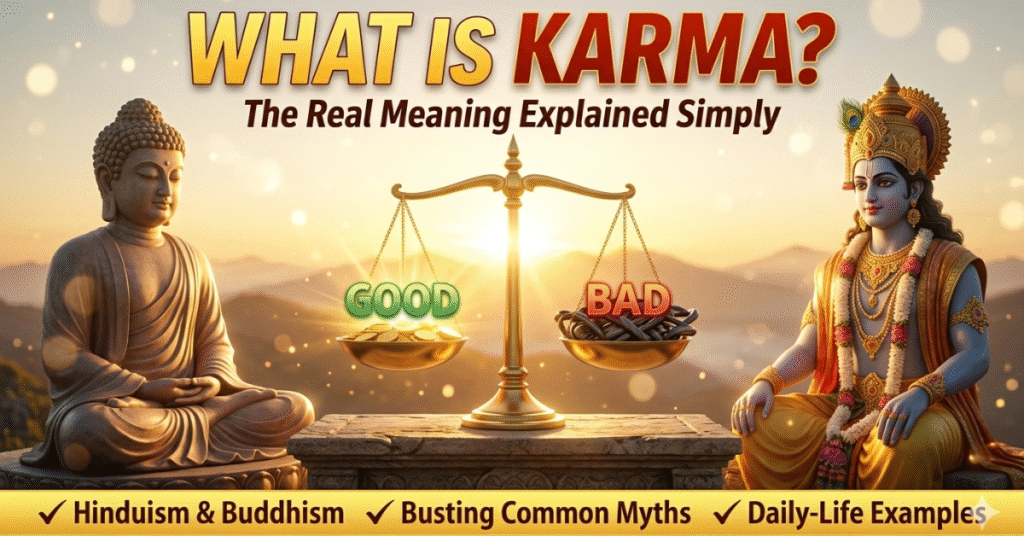
- Good actions (good karma) lead to positive outcomes.
- Bad actions (bad karma) lead to negative outcomes.
But here’s the important part—karma doesn’t always give instant results. It can take time, even lifetimes, to show its effects.
Example:
If someone constantly helps others without expecting anything in return, they build positive karma. Over time, they may experience peace, respect, and support from others.
Karma in Buddhism
In Buddhism, karma is more about intention than just action.
Key idea:
- Your intention (why you do something) matters more than the action itself.
Example:
If you donate money just to show off, the karma is not as positive as helping someone with genuine kindness.
So, in Buddhism:
Good intention = Good karma
Bad intention = Negative karma
Common Myths About Karma (And the Truth)
Myth 1: Karma is Instant Punishment
Many people think that if someone does wrong, they will suffer immediately.
Truth:
Karma doesn’t always work instantly. It can take time.
Example:
A dishonest person may succeed for some time, but eventually, their actions catch up—through loss of trust or relationships.
Myth 2: Karma Means Fate
Some believe everything is already decided because of karma.
Truth:
Karma is not fate. It’s about choices.
Example:
Even if you had a bad past, you can change your future by making better decisions today.
Myth 3: Karma Only Works in the Next Life
People often think karma only affects rebirth.
Truth:
Karma also affects your current life.
Example:
If you constantly spread negativity, you may face stress and conflict in your daily life.
Myth 4: Karma is Just About Good and Bad
Many people see karma as a simple reward-punishment system.
Truth:
Karma is more about learning and growth.
Example:
A failure in life may actually teach you lessons that lead to future success.
Also Read:- You Won’t Believe These 10 Life-Changing Lessons from Lord Krishna (With Real-Life Examples!) – lostnews
Karma in Daily Life (Simple Examples)
Understanding karma becomes easier when we see it in everyday situations:
1. At Work
If you work honestly and help your team, people trust you. That’s positive karma.
2. In Relationships
If you respect others, you receive respect. If you hurt people, relationships suffer.
3. In Personal Growth
If you keep learning and improving, your life naturally moves forward.
4. On Social Media
Spreading negativity leads to arguments and stress. Sharing positivity builds a better environment.
Why Understanding Karma Matters Today
In today’s fast-paced world, people often look for quick success. But karma teaches patience, responsibility, and awareness.
It reminds us that:
- Every action has consequences.
- Every choice shapes our future.
- We are responsible for our own lives.
Instead of blaming luck or fate, karma encourages us to take control.
Final Thoughts
The real meaning of karma is simple yet powerful—it’s about cause and effect in life.
Whether you believe in Hinduism or Buddhism, the core idea remains the same:
What you do today creates your tomorrow.
So, instead of worrying about what others are doing, focus on your own actions, intentions, and mindset.
Because in the end—
Your karma is your responsibility.