
The term Panch Kedar refers to a group of five sacred Hindu temples dedicated to Lord Shiva, located in the majestic Garhwal Himalayas of Uttarakhand. These temples are not just religious sites but are deeply rooted in mythology, history, and spiritual traditions that continue to inspire millions of devotees even today.
This article explores the complete journey of Panch Kedar—from its mythological origins and the story behind its name to its relevance in modern times.
What Does “Panch Kedar” Mean?
The name Panch Kedar is derived from two Sanskrit words:
- “Panch” means five.
- “Kedar,” meaning fields or the name of Lord Shiva in this region
So, Panch Kedar literally translates to “the five sacred shrines of Lord Shiva.”
These five temples are:
- Kedarnath Temple
- Tungnath Temple
- Rudranath Temple
- Madhyamaheshwar Temple
- Kalpeshwar Temple
Each of these temples represents a different part of Lord Shiva’s divine form.
Mythological History: The Story Behind Panch Kedar
The history of Panch Kedar is closely linked to the Indian epic, the Mahabharata, and the story of the Pandavas.
After the Kurukshetra War
After the great Kurukshetra War, the Pandavas were burdened with guilt. Even though they fought for righteousness, they had killed their own relatives (Kauravas) and many Brahmins. To cleanse themselves of this sin, they sought the blessings of Lord Shiva.
Shiva Avoids the Pandavas
Lord Shiva, however, was displeased with the violence and deceit of the war. To avoid meeting the Pandavas, he took the form of a bull (Nandi) and hid in the Himalayan region of Garhwal.
The Pandavas searched for him tirelessly and finally reached the Himalayas.
Bhima Recognises Shiva
One day, Bhima, the strongest of the Pandavas, spotted a strange bull grazing in the fields near Guptkashi. He immediately realised that it was Lord Shiva in disguise. When Bhima tried to catch the bull, it began to disappear into the ground.
The Divine Transformation
As the bull vanished, different parts of Shiva’s body appeared at five different locations:
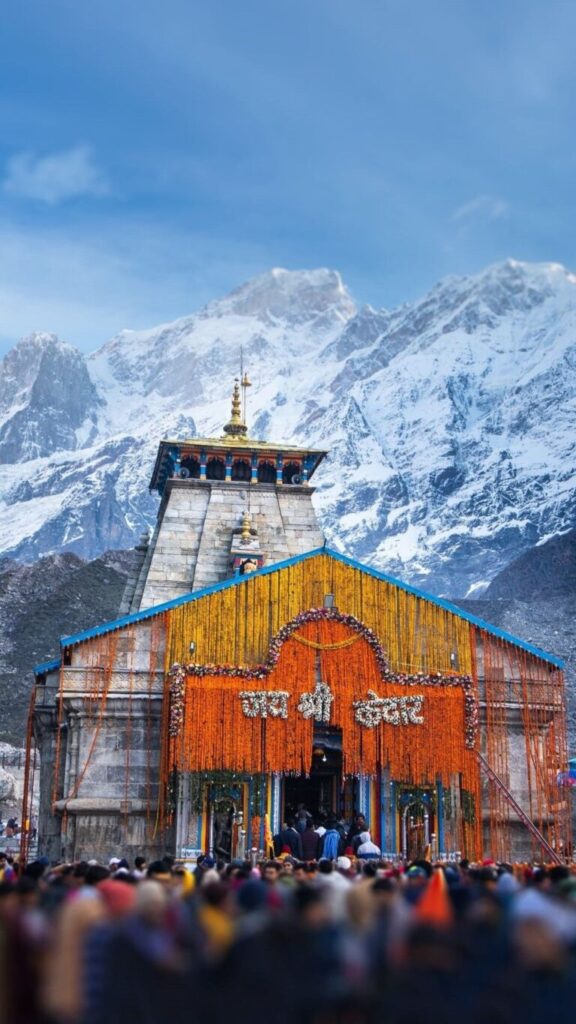
- Hump → Kedarnath
- Arms → Tungnath
- Face → Rudranath
- Navel (stomach) → Madhyamaheshwar
- Hair (matted locks) → Kalpeshwar
These five places later became the Panch Kedar temples.
The Pandavas built temples at each of these locations and worshipped Lord Shiva to seek forgiveness. Eventually, they were freed from their sins.
Historical and Cultural Significance
While the origin of Panch Kedar is rooted in mythology, its importance has grown over the centuries into a major Hindu pilgrimage circuit.
Connection with Ancient Traditions
The Panch Kedar Yatra is believed to be associated with ancient ascetic traditions, including the Nath sect and Himalayan yogis. Some traditions even link the pilgrimage route to Nepal’s famous Pashupatinath Temple, where Shiva’s head is worshipped.
Architecture and Geography
These temples are built in traditional North Indian Himalayan architecture and are located at high altitudes, surrounded by snow-covered peaks like Kedarnath, Chaukhamba, and Neelkanth.
Most of these temples are accessible only through trekking, making the journey both physically challenging and spiritually rewarding.
Religious Importance of Panch Kedar
Panch Kedar holds a special place in Shaivism (the worship of Lord Shiva). Among the five temples, Kedarnath is the most prominent and one of the 12 Jyotirlingas, making it extremely sacred to devotees.
Also Read:- 12 Jyotirlingas of India Spiritual Gems of India
Ritual Belief
There is a traditional belief that after completing the Panch Kedar Yatra, devotees should visit Badrinath Temple (dedicated to Lord Vishnu) to complete their spiritual journey.
This symbolises the balance between Shiva and Vishnu worship in Hindu philosophy.
Panch Kedar in Modern Times
Today, Panch Kedar is not just a religious journey but also a symbol of India’s spiritual heritage and natural beauty.
Rising Popularity
In recent years, the number of pilgrims visiting Kedarnath and other Panch Kedar temples has increased significantly, reflecting growing interest in spiritual tourism.
Trekking and Adventure
The Panch Kedar Yatra has also become popular among trekkers and adventure enthusiasts. The journey involves trekking through forests, rivers, and high-altitude terrains, offering breathtaking views of the Himalayas.
Seasonal Accessibility
Due to heavy snowfall, most temples (except Kalpeshwar) remain closed during winter and reopen in summer (April/May to October).
Spiritual Meaning of Panch Kedar
Beyond mythology and geography, Panch Kedar carries deep spiritual symbolism.
Each temple represents a part of Shiva, reminding devotees that:
- God is present everywhere.
- Divinity can manifest in different forms.
- True devotion requires effort, patience, and faith.
The journey itself is seen as a path of self-purification—just like the Pandavas’ quest for redemption.
Conclusion
The story of Panch Kedar is a beautiful blend of mythology, devotion, and Himalayan heritage. From the Pandavas’ guilt after the Mahabharata war to the divine appearance of Lord Shiva in five forms, every aspect of this tradition carries deep meaning.
The name “Panch Kedar” reflects not just five temples but five sacred experiences—each one guiding a devotee closer to spiritual peace.
Even today, thousands of pilgrims undertake this challenging journey, not just to visit temples, but to reconnect with faith, nature, and themselves. In a fast-moving modern world, Panch Kedar continues to stand as a timeless reminder of devotion, repentance, and divine grace.